Wednesday, June 6, 2012

Review of Seiko Flight Master Automatic Chronograph


Model # SBDS001

Brand/Model:  Seiko Flight Master
Movement:  Japanese automatic
Material:  titanium case and bracelet
Complications:  date display, power reserve meter, chronograph timing in one second increments up to 12 hours
Price:  MSRP:  about $4,500 USD; street price around $3,500 USD


Plenty of photos follow the review.  Click on the pictures to enlarge.


Watch aficionados always enjoy something different, and many times that means acquiring a watch that is not sold in the market they live in.  In the U.S., it could be getting a Tudor, or some other Swiss brand that is not officially sold in the states.  Many times, getting a Japanese Domestic Market (JDM) watch fits the bill.  

Japanese watch companies like Seiko and Citizen make an entire range of very cool watches that are not officially sold outside of Japan proper, so getting a JDM watch can be a source of pride for many a WIS.  In my case, I wanted a Seiko Flight Master automatic chronograph ever since I first saw pictures of one many years ago and the stars finally aligned to enable me to purchase one.  Even though it’s not a Spring Drive or a Grand Seiko, I feel it’s one of Seiko’s finest pieces.

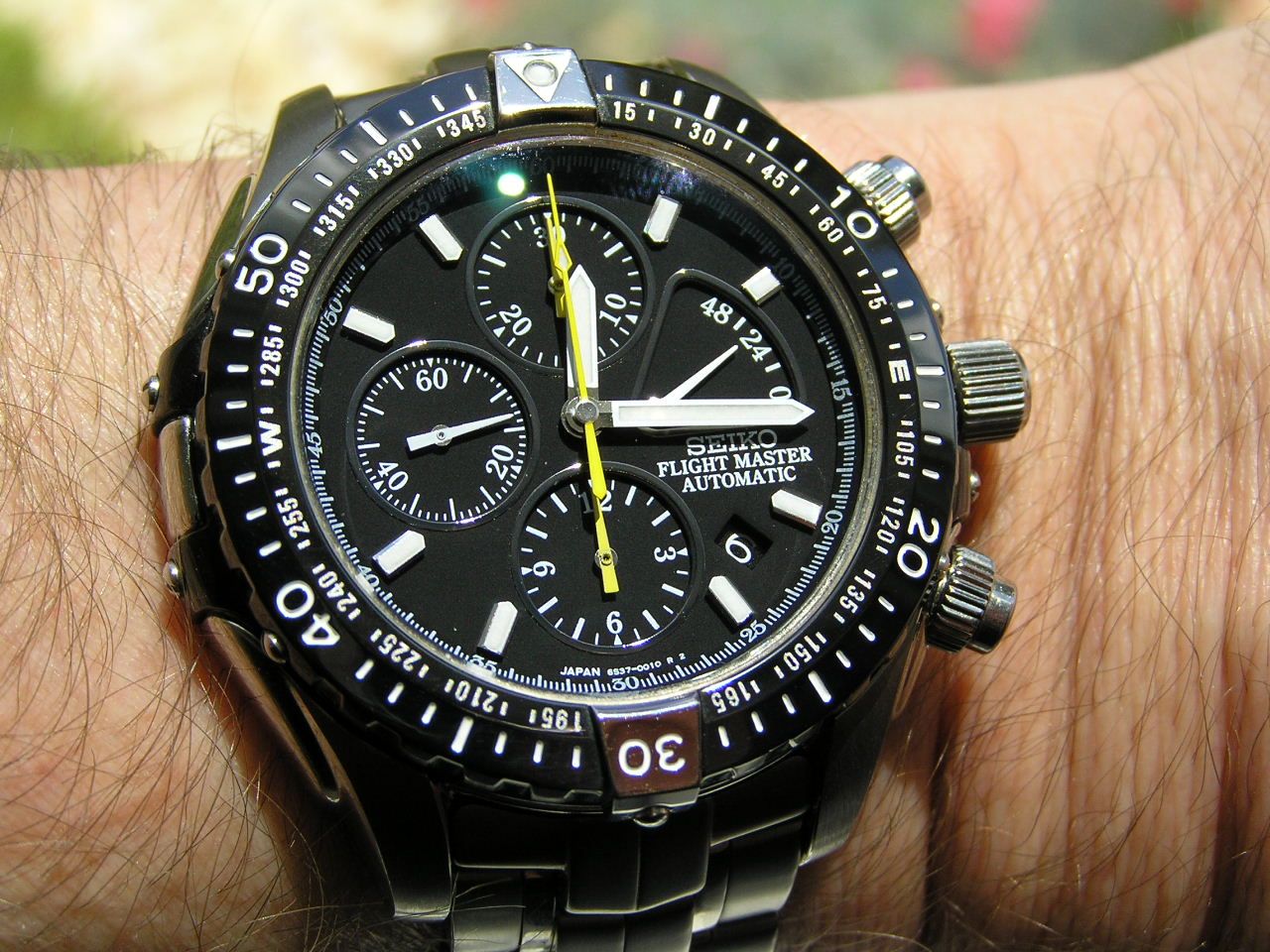
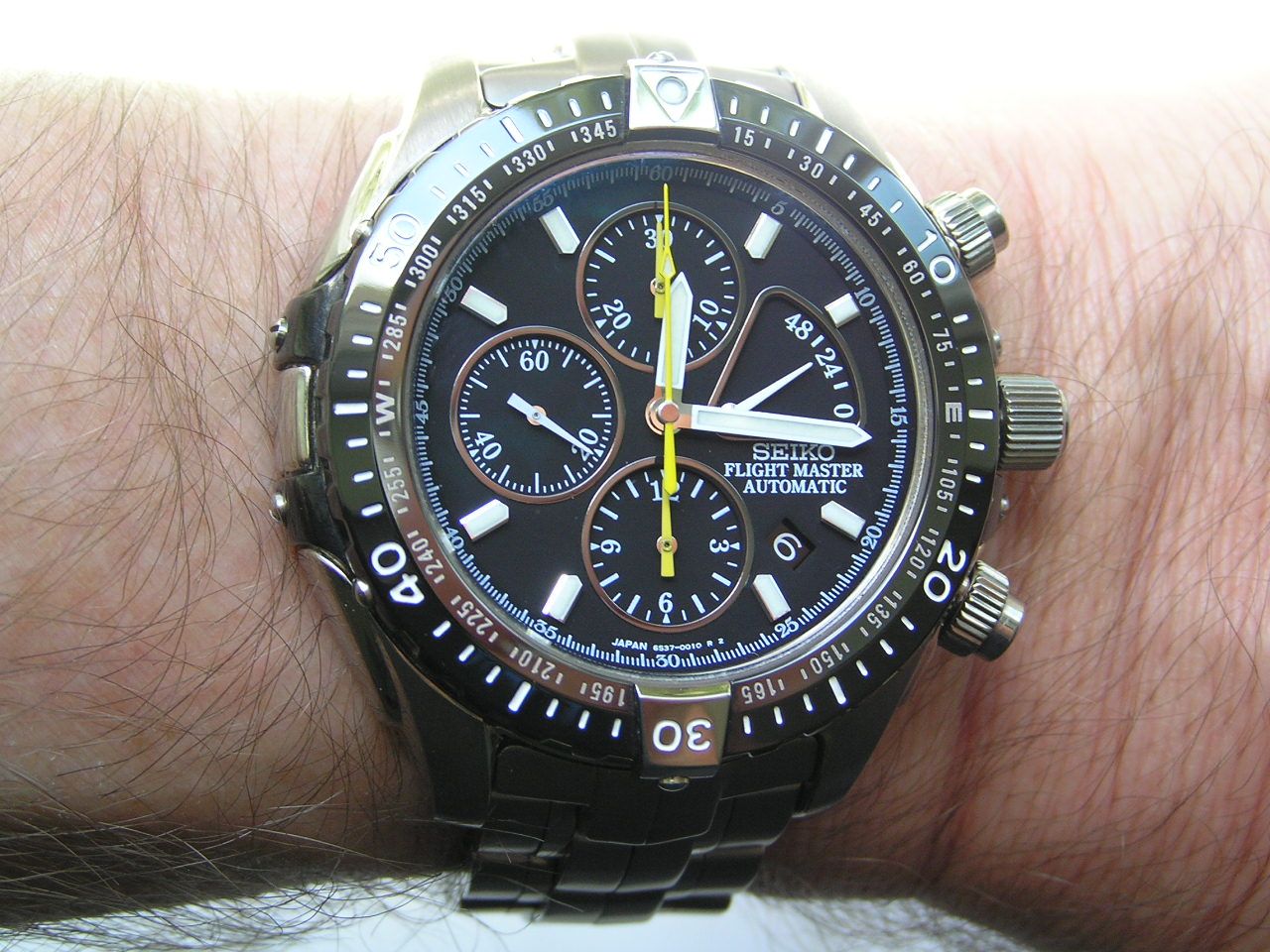
The Flight Master packs a lot of features into a relatively compact watch.  Loaded with a 12-hour chronograph, 48-hour power reserve meter and date display, along with a timing bezel with compass function, about the only thing the Flight Master lacks is a GMT hand.  But I’m not complaining.

The Flight Master sports a nicely polished and brushed all titanium case (I love the look of polished Ti) that measures 42.4mm without the longish signed screwdown crown.  With the crown included, diameter is 48.3mm. 

Case thickness is 14.9mm, lug width is 20mm.  The caseback screws down and is a display type, showing the intricacies of the 40-jewel column wheel chronograph movement.  The movement really isn’t decorated, but the finish level is acceptable and the rotor is signed.

Since the Flight Master is crafted of titanium alloy, the entire watch is fairly lightweight, but not too light.  It’s a nice balance of svelte and presence combined.  It does tend to sit a bit high on the wrist, but not in an annoying way and being titanium, it is not top heavy.

The Flight Master is factory rated for 100 meters (10 bar) of water resistance.

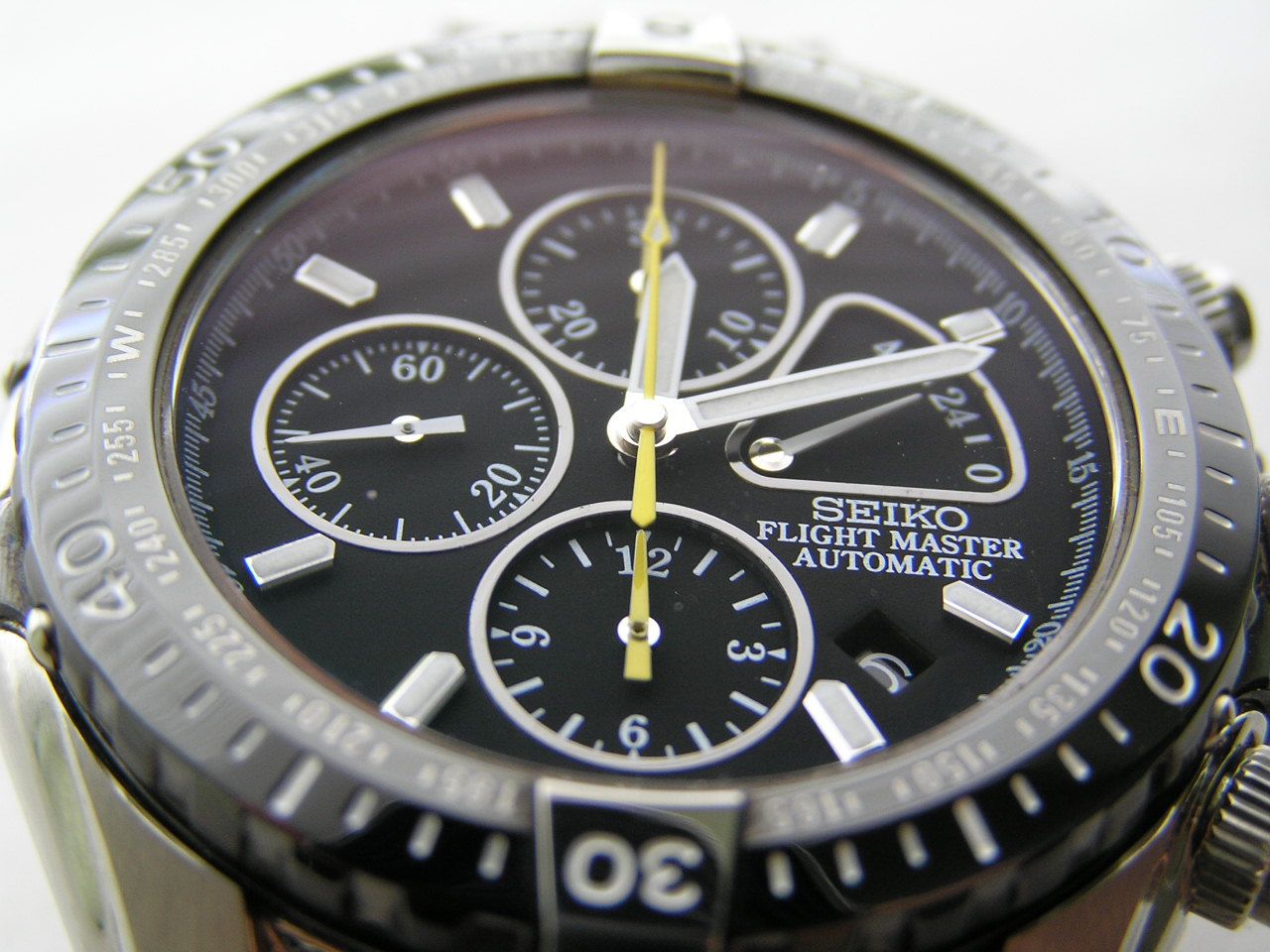
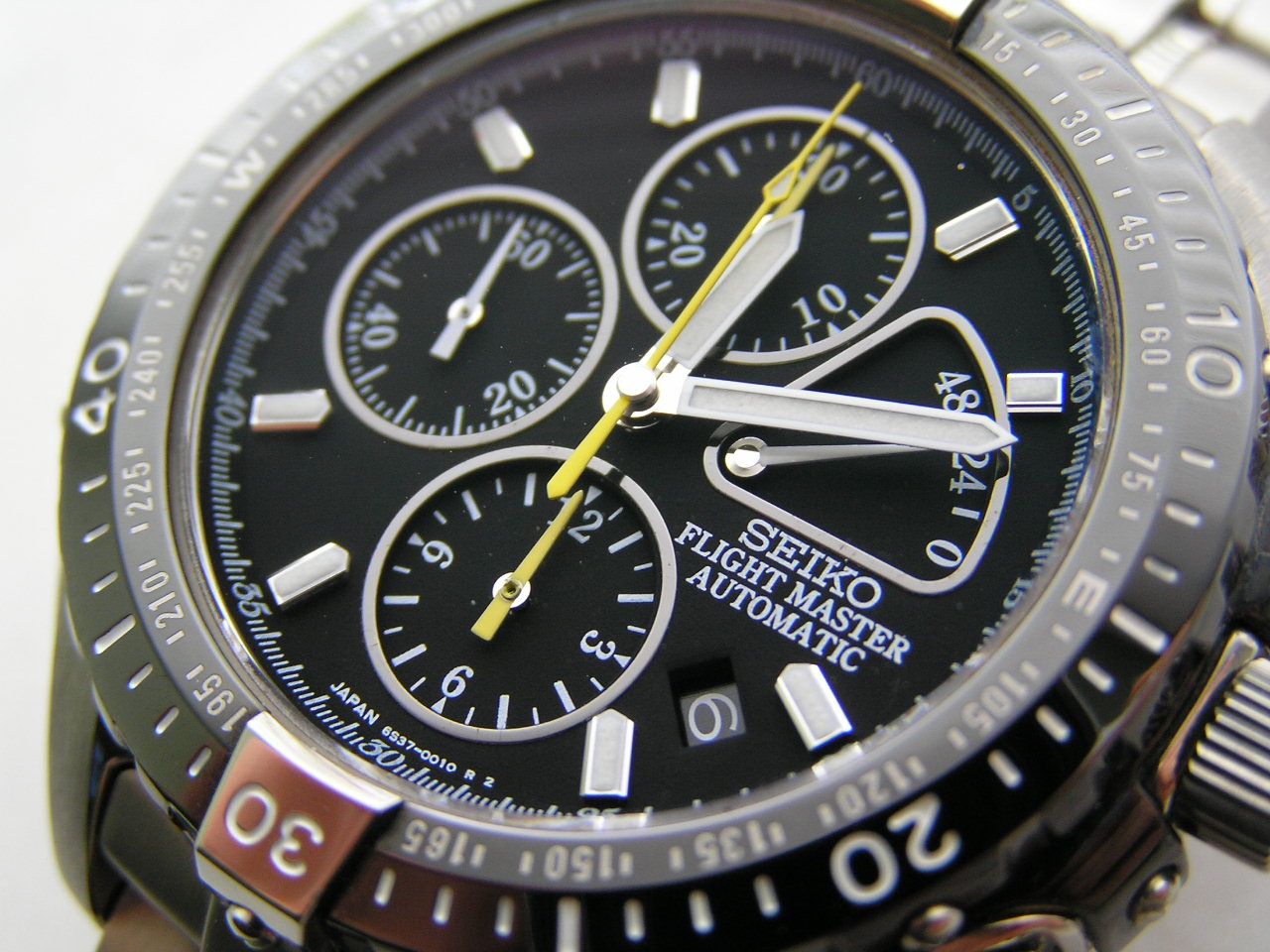
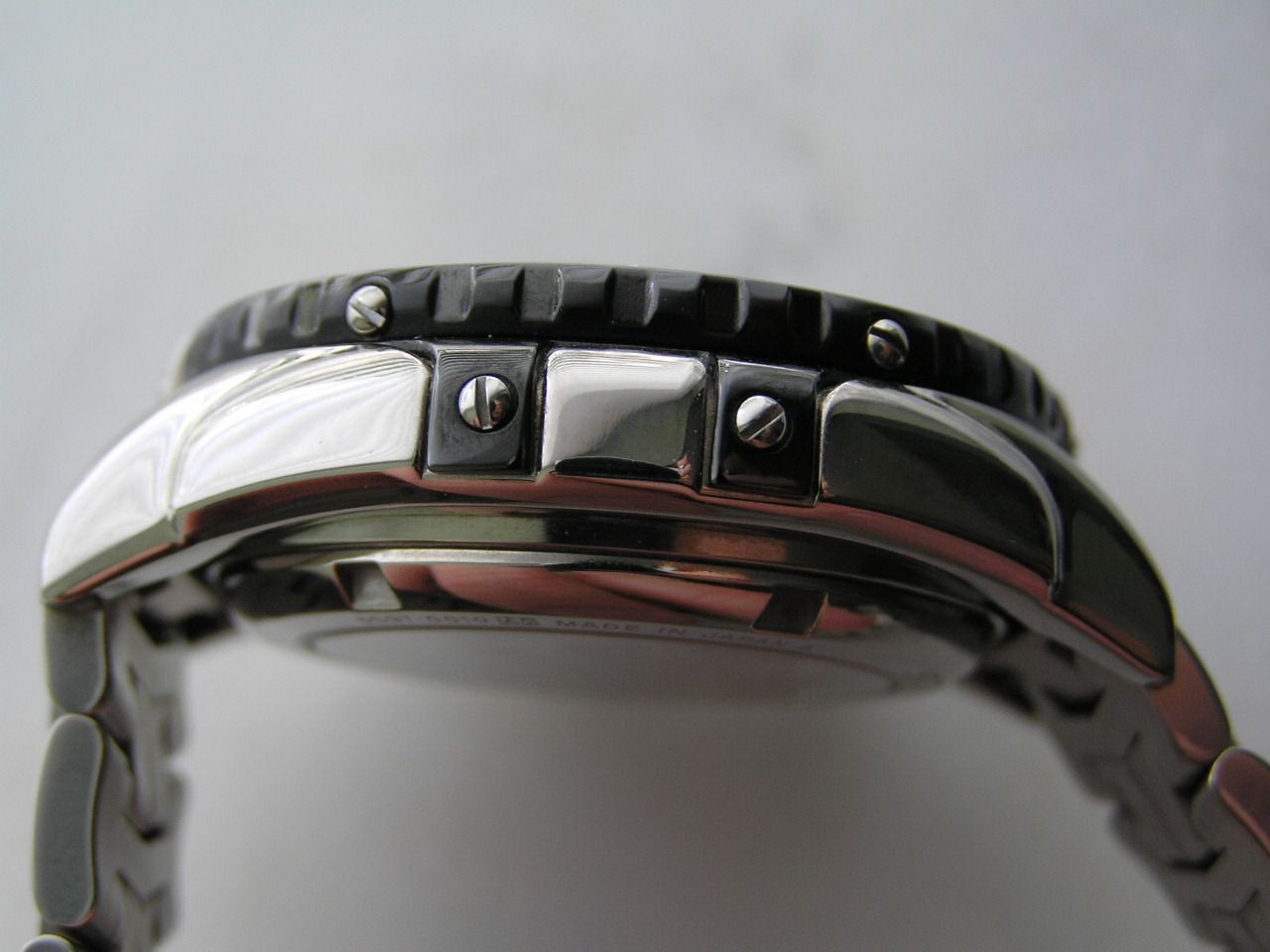
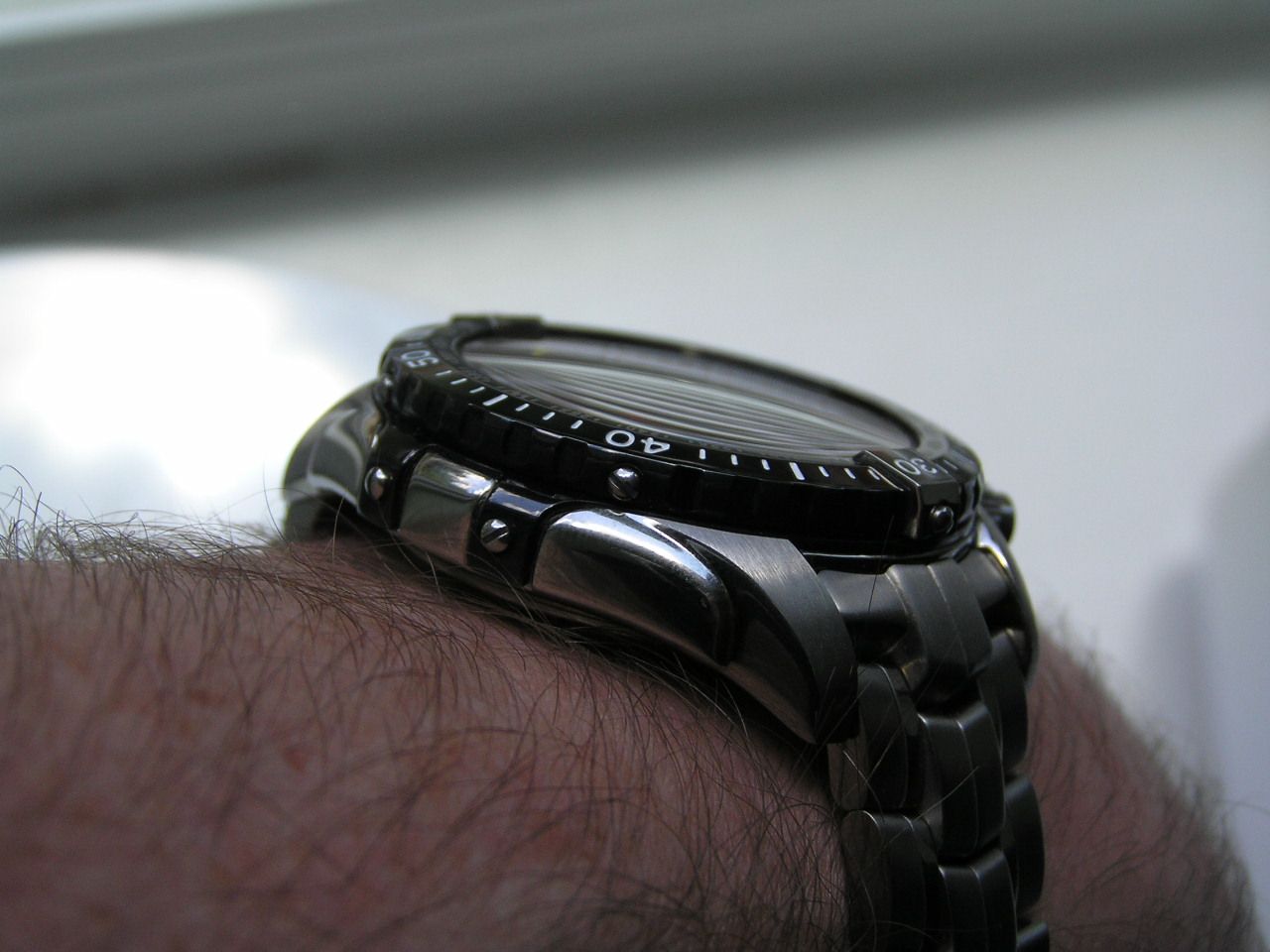
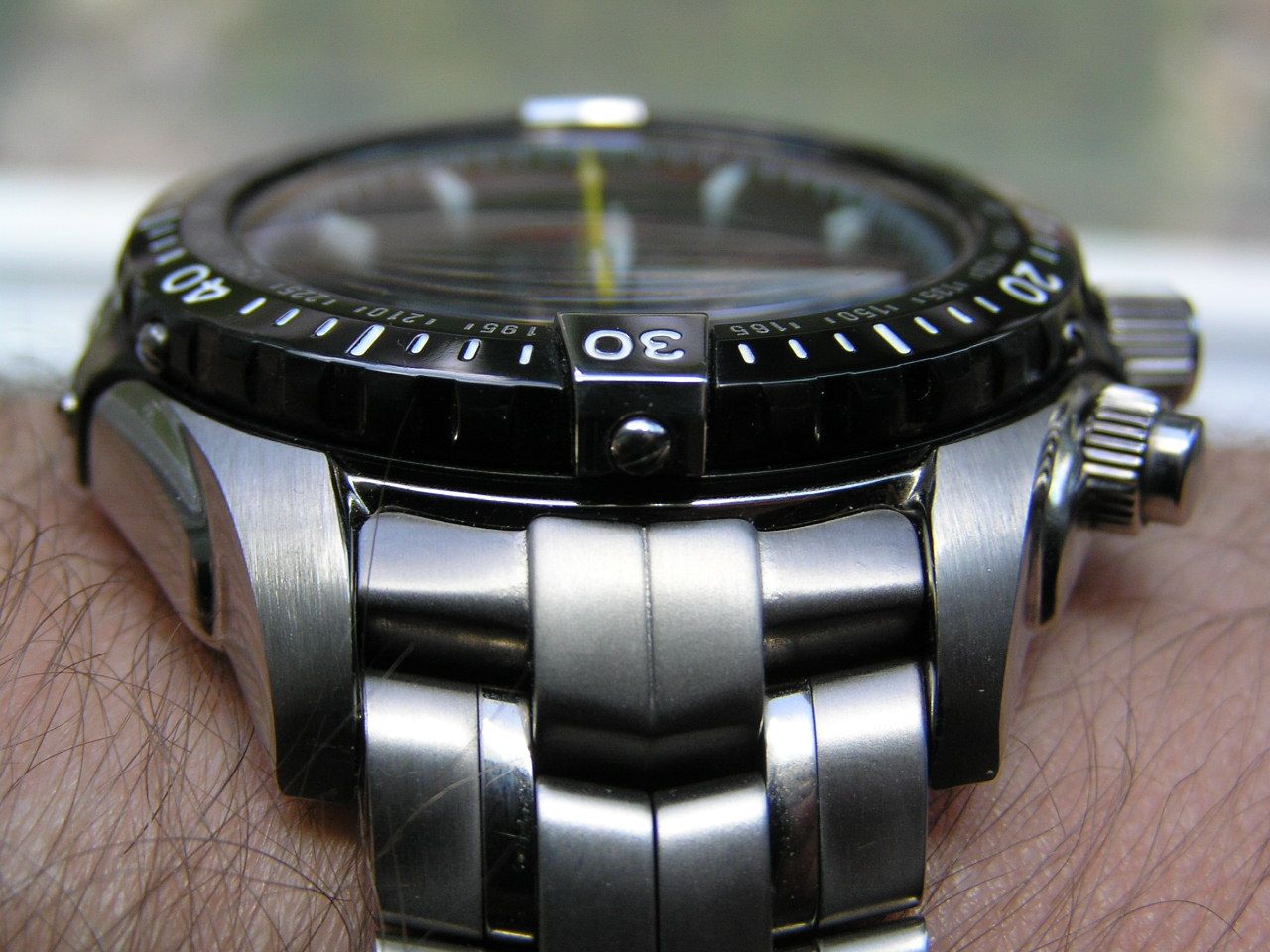
The 120-click omnidirectional rotating bezel sports Breitling-esque rider tabs at the 12 and 6 positions, with six small screws on the side of the bezel at each 10 minute mark, again, very Breitling-like in design.  The bezel itself is finished in black ion plate and is fully marked in white with either hash marks or arabics.  A small compass track with degree markings is located on the inside of the bezel between the timing marks and the crystal.  These markings are very small and pretty hard to see, if you need reading glasses, better bring them! 

A small lume pip is located in the center of the rider tab at 12.  Bezel action is a bit disappointing, rather loud and gritty feeling, not nearly as smooth and crisp as I would expect at this price point.

As a design element, Seiko has two black ion plated tabs that fold down over the sides of the case, between the crown and chrono pushers and on the opposite side of the case, on either side of the 9 position.  This design gives the effect of the bezel sort of snapping over the top of the case, with each of the four tabs being secured by a small screw.  An interesting if questionable detail.

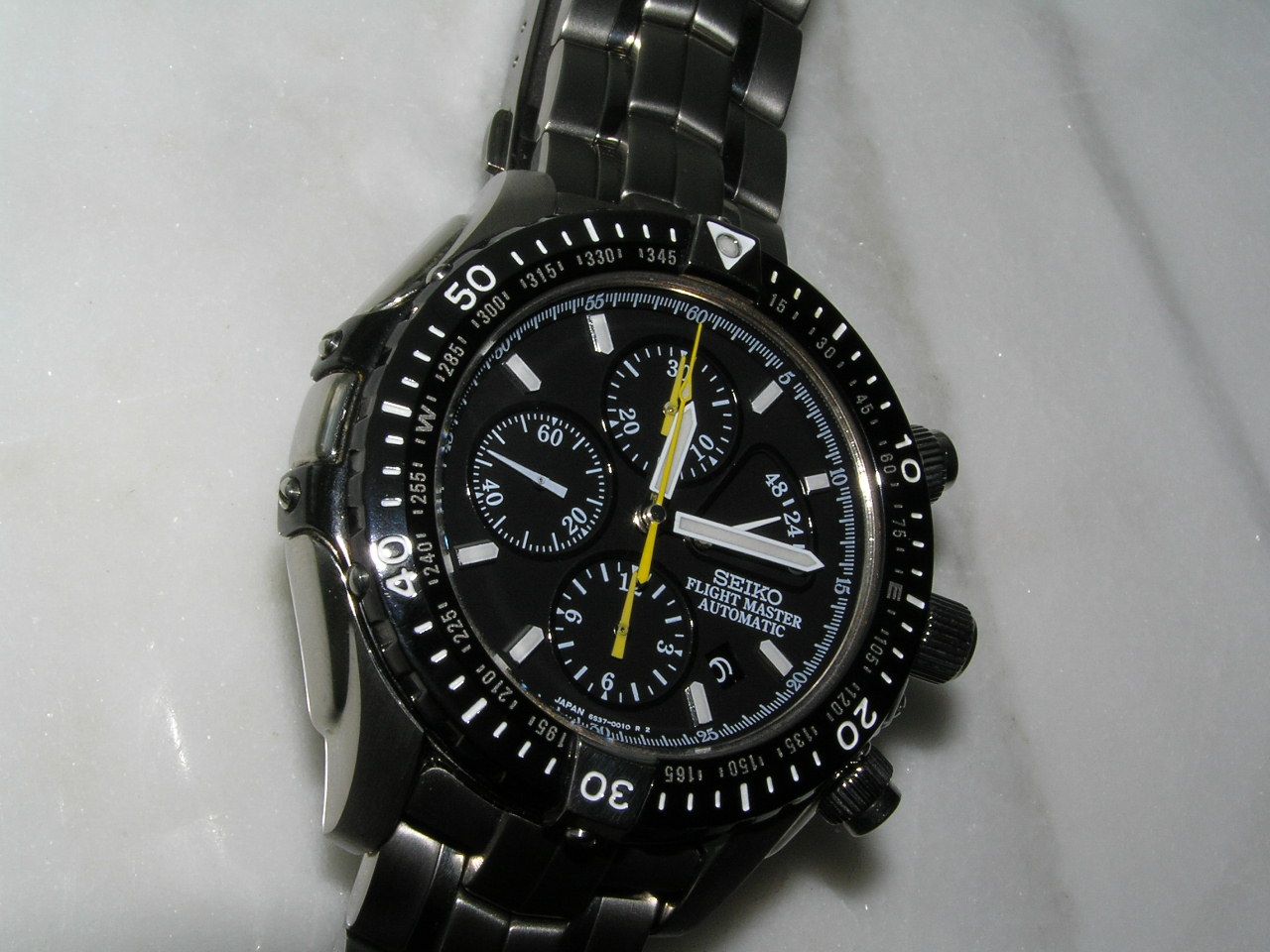
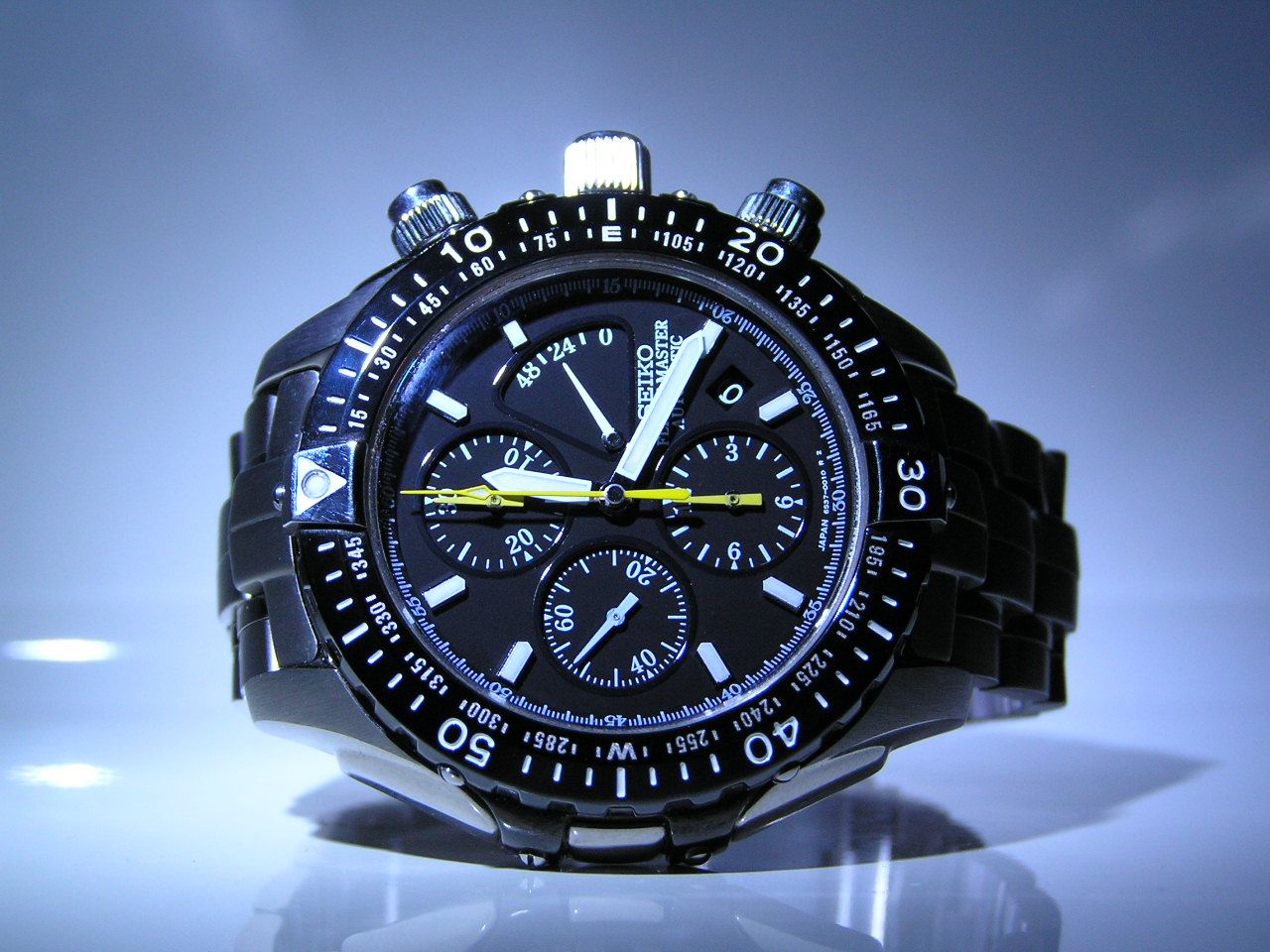
The dial on the Flight Master is all business and a great example of clarity and legibility, given all the functions of this watch.  The hour and minute hands are silver with inset lume, as are the applied markers at each five minute mark (there are no markers at the 12, 3, 6, and 9 positions).  The dial itself is a perfect matte black.

The subdial at 9 is the seconds hand for the watch.  The subdial at 12 is the chronograph minute totalizer and the subdial at 6 is the 12-hour chrono totalizer.  Both these subdials have yellow hands, to match the chronograph’s center second hand, which is in yellow as well and makes it easy at a glance to read chronograph timing.  Nicely done!

A quickset date window is located at 4:30, with a proper white on black date wheel that aligns perfectly in the window.  The 48-hour power reserve meter resides between the 2 and 3 position and is very easy to read as it sweeps through a roughly 60 degree arc. 

Lume quality is excellent, as Seiko’s Lumibrite is always expected to be.  Small tasteful lettering directly below the power reserve meter, with just the wording ‘Seiko,’ ‘Flight Master,’ and ‘Automatic’ appearing on the dial.

The Flight Master has a mildly domed sapphire crystal that is slightly recessed from the top of the bezel.  The crystal has a very effective anti-reflective coating on it, it’s one of those watches that looks at times to be missing its crystal.  This helps in making the dial very easy to read in most all lighting conditions.

The main time and date setting crown, as previously mentioned, is fairly long, so it’s easy to grip and is signed with an engraved ‘S’.  The chronograph pushers have a positive, smooth feel to them and one unique aspect is they lock in opposite of most screwdown pushers.  When the pushers are screwed in against the case, the chrono can be activated.  To lock the pushers, you have to unscrew them away from the case.  This is opposite of how my other watches with screwdown pushers operate.  Nothing wrong about it, but an interesting feature to note.

Inside the Flight Master is Seiko’s Japan-made 40-jewel automatic column wheel chronograph movement.  It winds and sets well and all the chrono functions start, stop and reset as they should.  I was a bit disappointed in the daily accuracy of this movement at first, as it was running at +16/24 hours, although as time has passed, it has been getting better, currently at about +8/24 hours.  I would have expected more accuracy from the factory at this price point, but it could probably be regulated even tighter than it is now if need be.  Although the power reserve meter only goes to 48 hours, the Flight Master has returned a superb 53-1/2 hour power reserve, so no complaints there.

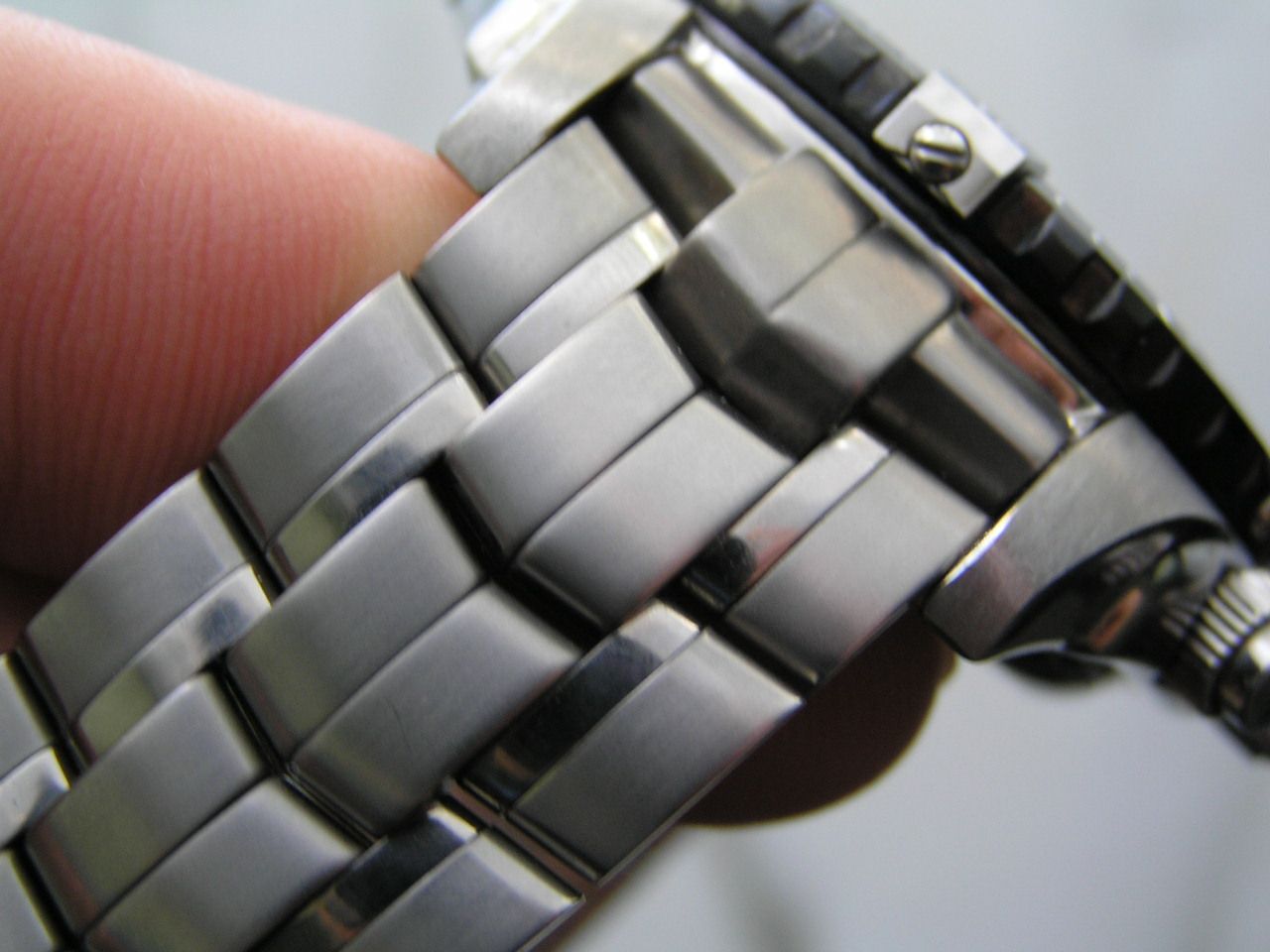
The bracelet on the Flight Master is solid link titanium that is polished and brushed.  End links are solid and the clasp is pretty much standard-issue Seiko, that is signed, with a pushbutton release and fold over safety clasp, although the deployant is a proper machined type.  There is no diver extension and five micro adjustment holes on the clasp. 

The bracelet measures 20mm at the lugs and tapers to 18.7mm at the clasp.  Sizing was straightforward and with the number of microadjustment holes provided, a good fit is all but assured.

Presentation for the Flight Master is typical Seiko Prospex series, a rather unexciting box emblazoned with the brand lettering in yellow.  I think a watch this special deserves a nicer box.

Overall, the Flight Master resonates with me because it is unique, hard-to-find and accomplishes so much in a well designed package that represents the capabilities of Seiko and their upper end series.  Ask most people on the street and they would scoff at spending several thousand dollars on a Seiko, but when you see the Flight Master in person and look at its craftsmanship, you know you have something special to justify the price.

Pros: lighter weight titanium design, super looking dial, excellent functionality, great in-house Seiko movement, added bonus of power reserve meter on a chronograph 

Cons:  fairly shallow water resistance rating, bezel action should be smoother, clasp could be higher grade to better match price point, uninspired packaging

Verdict:  a superb all-around chronograph with great quality and features, some could probably get by as having this be their only watch, an awesome high-end Seiko

Thanks for reading and enjoy the pictures.

Excelsior!

-Marc


Thursday, May 3, 2012

Review of Glycine Airman Base 22 Purist


Model # 3887.18/66

Brand/Model:  Glycine Airman Base 22 Purist
Movement:  Swiss automatic
Material:  stainless steel case and bracelet (watch shown here on aftermarket crocodile strap)
Complications:  date display
Price:  MSRP:  $1,995; street price around $1,200 USD


Plenty of photos follow the review.  Click on the pictures to enlarge.


I tend to write about a lot of watches that I consider to be ‘iconic.’  Maybe because objects that I consider to be classics appeal to me.  The Glycine Airman is no exception to both the iconic and classic camps.  Glycine introduced the Airman in 1953 and this model (and variations thereof) has been in continuous production ever since.  There’s plenty more history on the Airman at Glycine’s web site.  I just wanted to give the briefest of overviews before getting to the meat of this review.

Although most people (like me) have no practical use for a 24-hour watch (a watch whose hands make only one revolution around the dial in a 24-hour period), I do think this style of watch is unique and I wanted to have an example for my collection, so what other choice than an Airman?

Glycine makes quite a range of Airman models these days, but I opted for the most classic and the simplest design, the Airman Base 22 Purist.  This model is a three hand (hour, minute, seconds) layout in a 24-hour format, with a rotating and lockable 24-hour bezel to track a second time zone.  A date display completes the features list.

Glycine watches are not the easiest to find in the U.S., but you can find a good selection on ebay or from European sellers.

The Base 22 Purist starts with a finely finished polished and brushed stainless steel case which measures 41.1mm without either of the two crowns; 45mm with the main winding and setting crown included.  The main setting crown is rather small, but it is signed and has enough knurls on it to give you a good grip when setting or winding the watch.  Even though the Base 22 Purist is an automatic, I still like to fully wind my automatics prior to wearing them, so a good, functional crown is a must for me. 

The larger crown at the four o’clock position is the locking crown for the 24-hour rotating bezel.  It’s an elegantly simple design, with a toothed locking tab that mates to the toothed edge of the bezel.  It meshes perfectly and just looks cool in its locked position.  This locking crown also has a nifty cross hatch pattern engraved into it, which is another nice touch.

The bezel itself is brushed finish stainless steel with all the even numbers indicated by a black arabic engraved into the bezel; the odd numbers are indicated by a black engraved pointer.

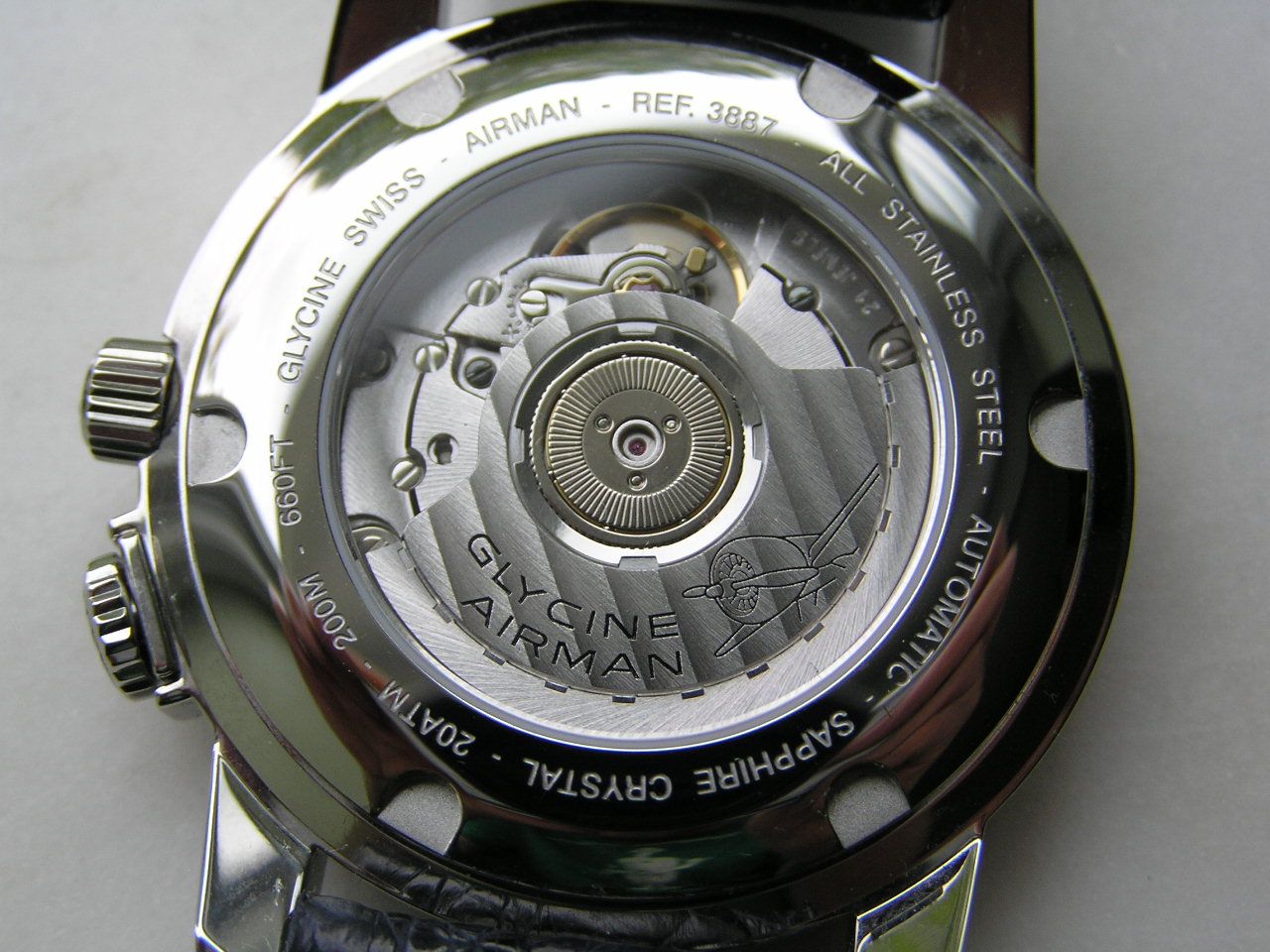
Case thickness is a rather slim 11.2mm, lugs are 22mm.  The lugs are drilled to make strap or bracelet swaps easy.  The caseback is a polished screwdown display type which shows off the ETA automatic movement with cool Airman engraved decorated rotor, which includes an airplane as part of the decoration. 

A flat sapphire crystal caps the dial on the Base 22 Purist.  The Base 22 Purist is water resistant to 200 meters.

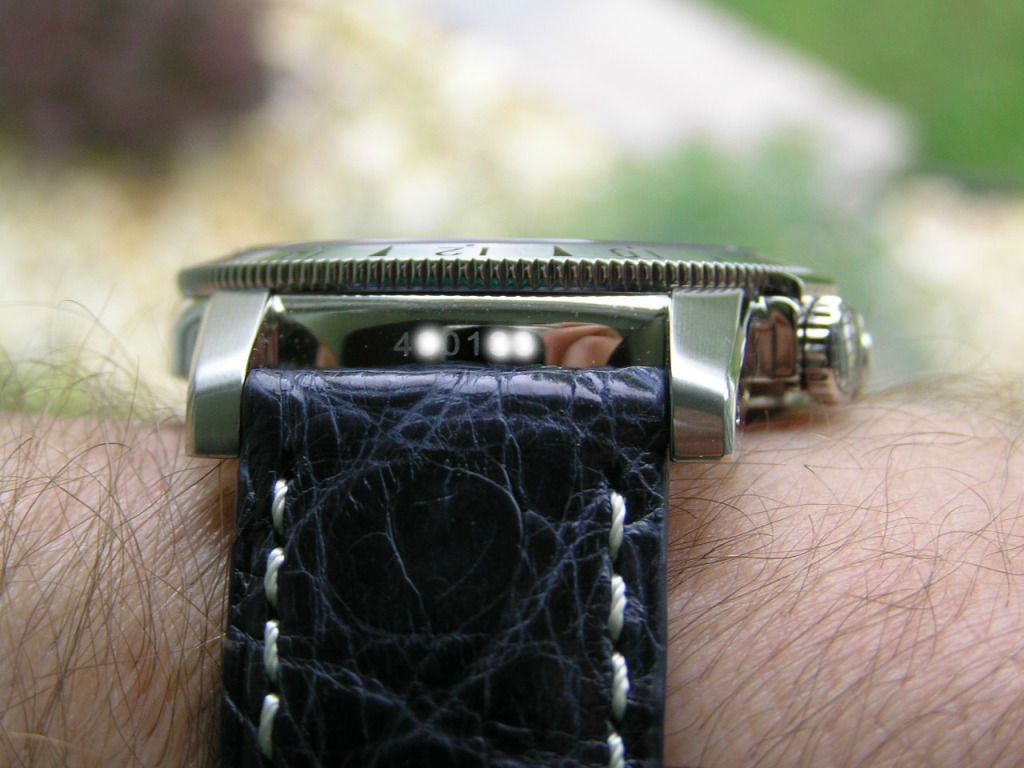
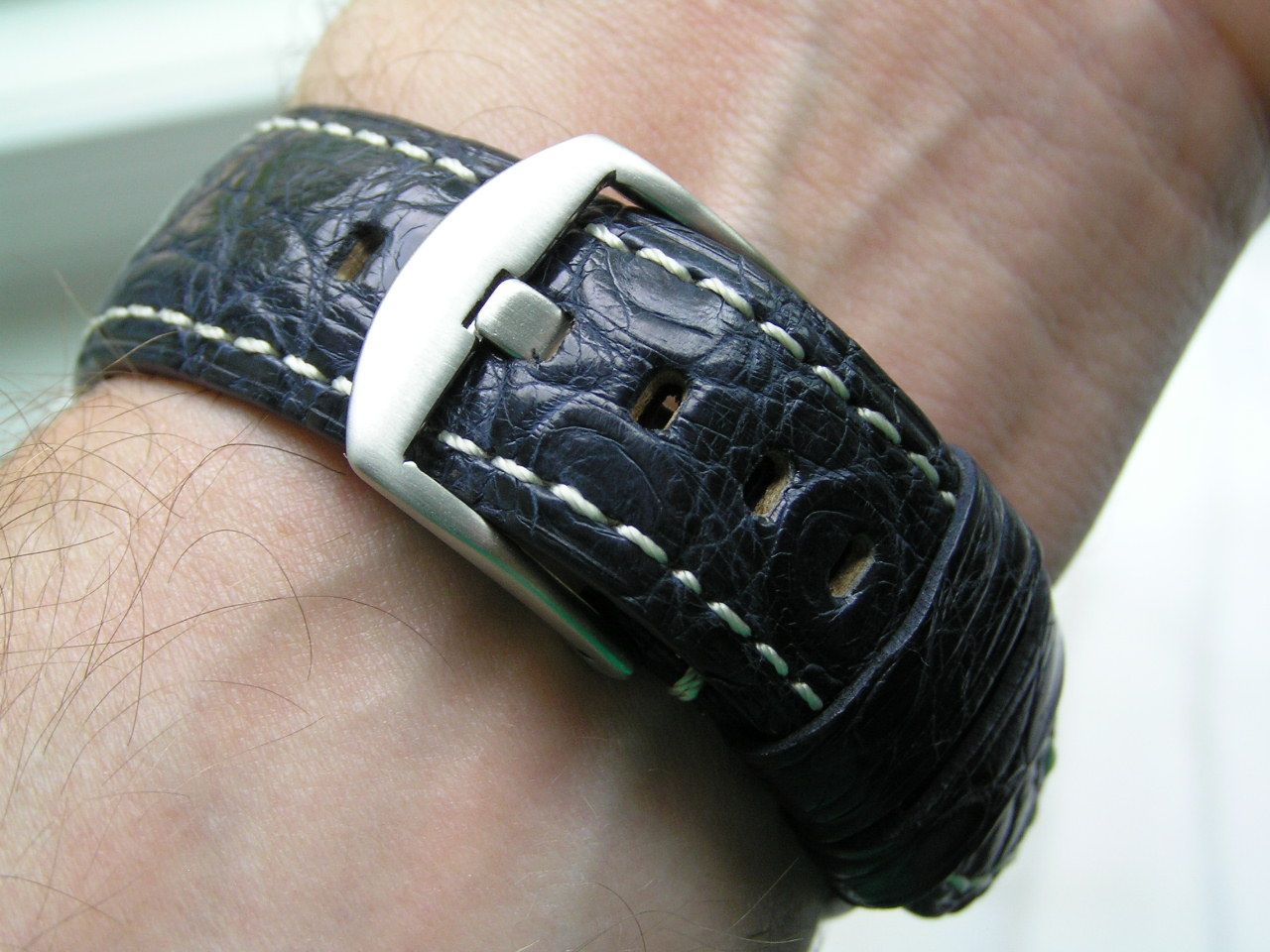
This watch comes on a solid link stainless steel bracelet with hollow end links and a signed double locking clasp with a cheap stamped steel deployant.  The bracelet is just okay, I felt it was rather cheap and rattle-prone, so I installed a 22mm dark blue genuine crocodile strap with white contrast stitching.  This is the strap shown in the pictures for this review.

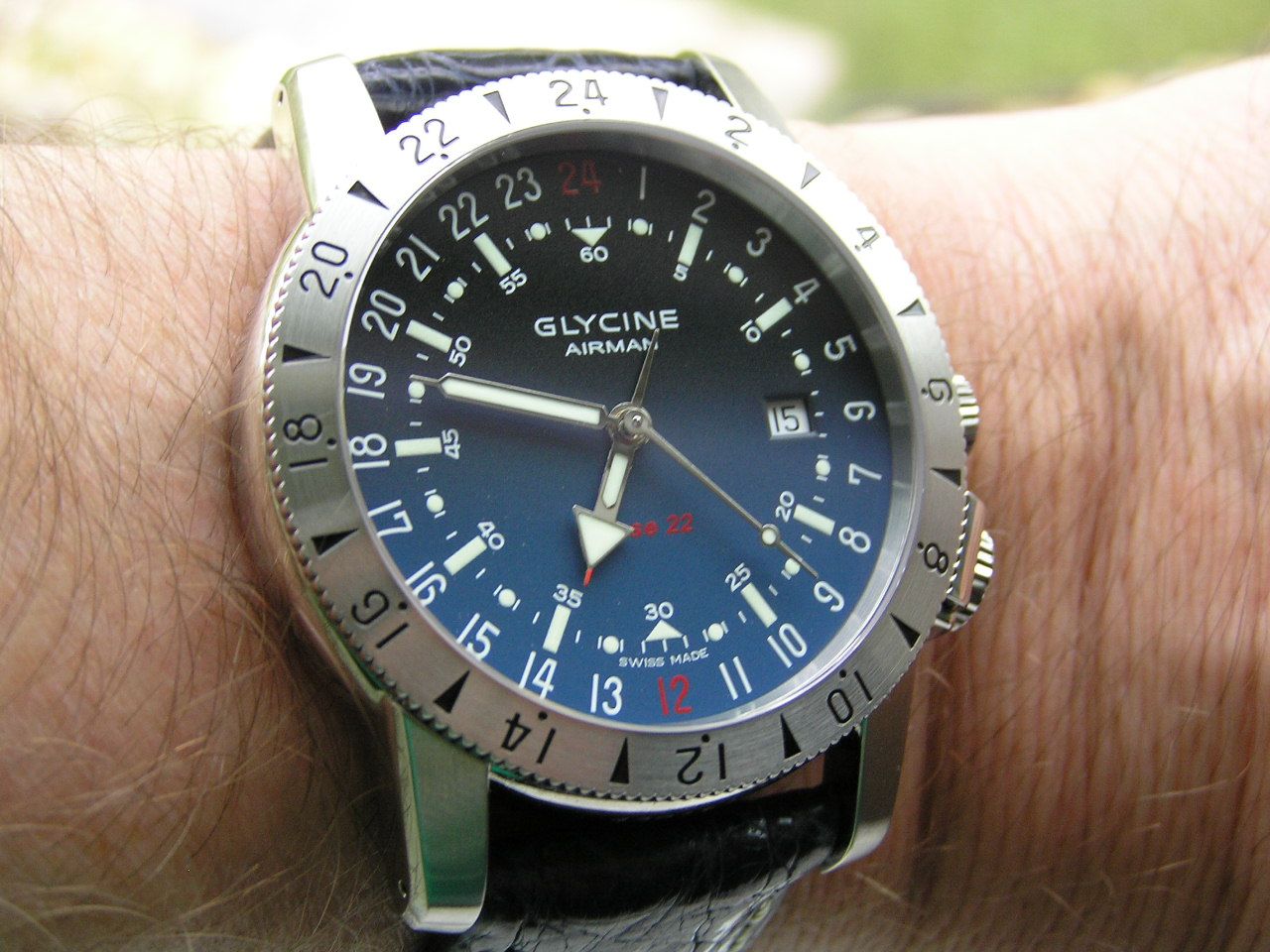
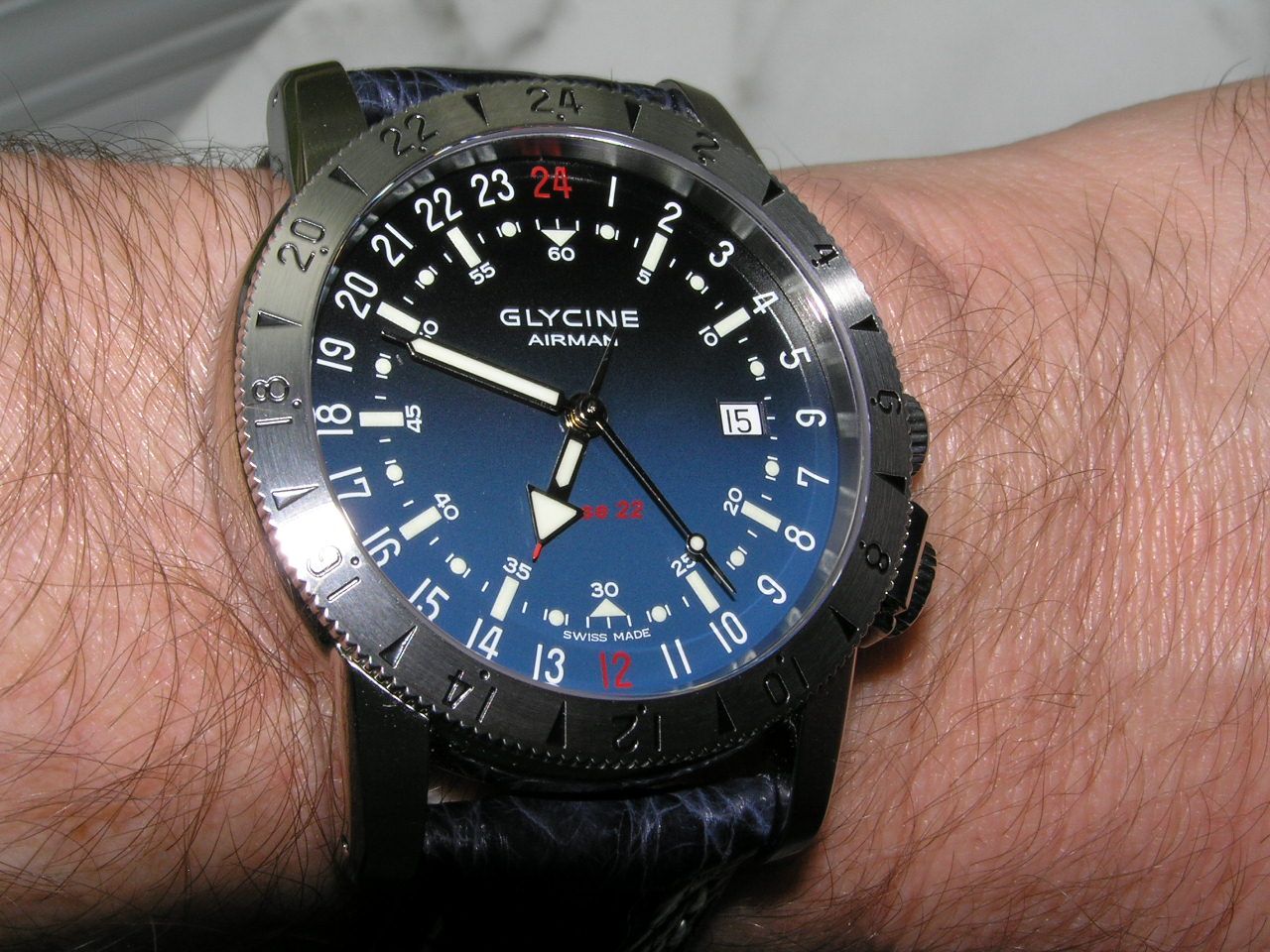
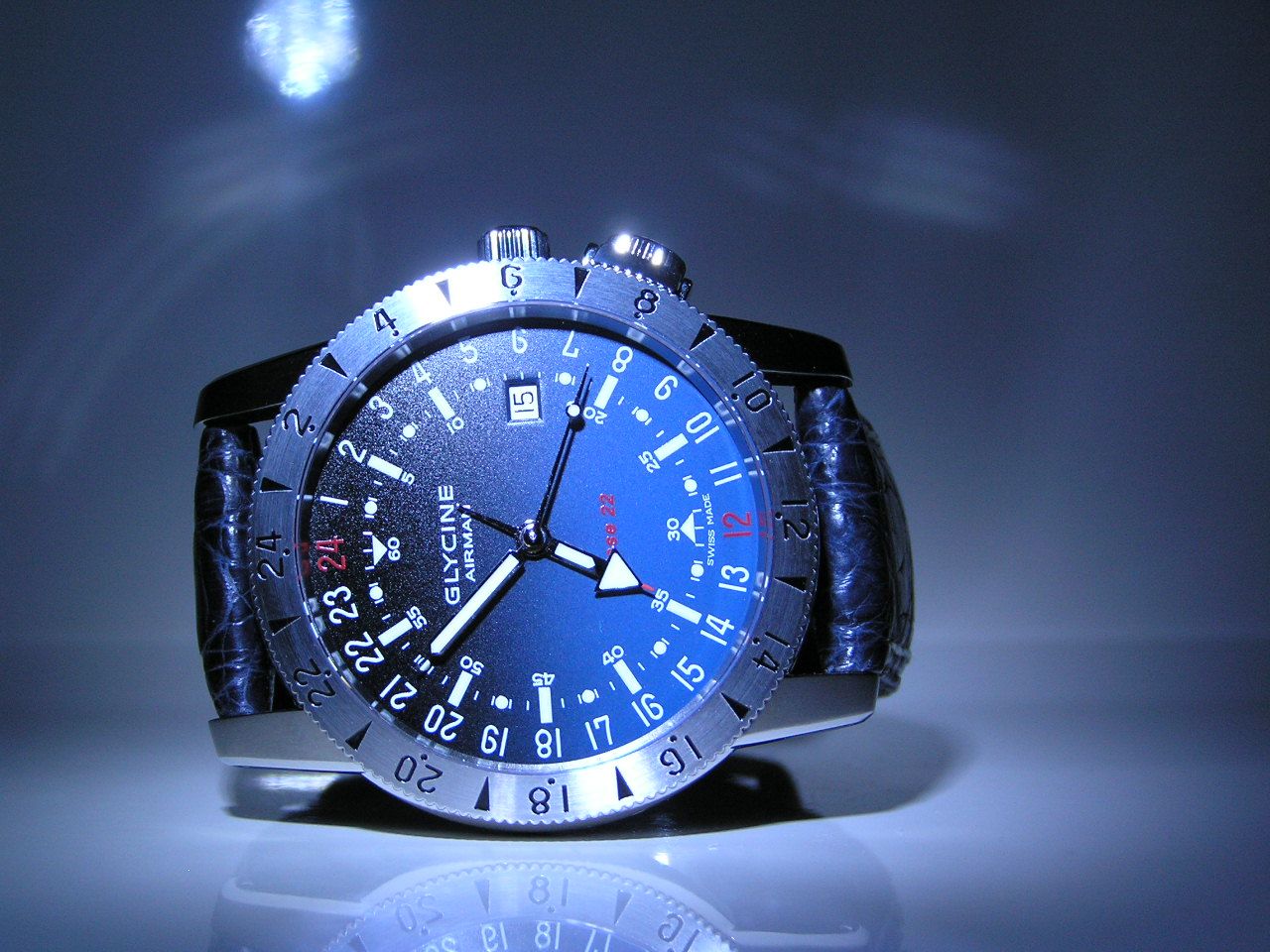
The dial on my Base 22 Purist is a darker blue to somewhat darker blue fade, with the darkest hue at the top, fading into the slightly lighter blue (but still dark) around the middle of the dial.  White printed arabics numbered 1 through 24 encircle the outer part of the dial, with the ‘24’ and ‘12’ printed in red.  A luminous triangle is above the red 24 and 12, with alternating luminous bar and circle markers running around the inside of the arabics.  Small arabics are printed just inside the luminous markers every five minutes.  The hour hand is arrow shaped with a fine pointed end tip in red, the minute hand is a stick style with a fine pointed end tip and the seconds hand is a stick style with ball end.  All of these hands are luminous.  Lume quality is rather good.

To make it easier to tell what time it is once the watch is into the afternoon or second half of the day (13 to 24 hours), the hour hand has a tail that extends partway into the opposite side of the dial, pointing to the corresponding time in 12-hour format.  For example, at 16:30 hours, the tail on the hour hand points between the ‘4’ and ‘5’ hour marks on the opposite side of the dial, letting the operator know that it’s 4:30 pm in 12-hour time.  Neat!

A quickset date window resides at the three position, the date wheel being black on white.  The window is large enough to clearly see the date and the alignment of the wheel inside the window is good.

Even with a dial that some may consider quite busy, with all the small arabics and markers, legibility of this watch is rather good and the overall look is fantastic.

Powering the Base 22 Purist is a tried and true Swiss Made ETA 2893-2 automatic movement.  With 21 jewels and beating at 28,800 vph, this workhorse engine should provide many years of consistent timekeeping.  The movement can be manually wound and also hacks to ensure accurate worldwide time synchronization.  Accuracy out of the box has been excellent, running at a consistent +5 seconds per day, with a long 48 hour power reserve.

As stated above, the standard stainless steel bracelet was rather disappointing to me, others may find its solid links and conventional end links and clasp to be satisfactory.  I just think a watch with this level of iconic status should be presented on a better quality bracelet, at least one with solid end links and a machined deployant.

Presentation is via a heavy black cardboard outer box with removable lid and a nice black inner box.  Glycine doesn’t include much in the way of documentation, but they do include instructions on how to best set the watch and 24-hour bezel for proper worldwide timekeeping.  A signed black polishing cloth is also part of the package, which is a thoughtful touch.

Overall, the Glycine Airman Base 22 Purist is, in the words of Glycine, ‘legendary.’  It’s a unique and highly useful watch with a true 24-hour display.  Good fit and finish, attractive looks and a cache that many other watches could only wish for, this watch does the job it’s been designed for and does so with class and style.  Bravo!

Pros:  iconic watch model, true 24-hour functionality, good fit and finish, dark blue fade dial looks cool 

Cons:  standard stainless steel bracelet could be better quality for price point, main crown could be a bit larger

Verdict:  even if you’re not a pilot, this is the 24-hour watch to have; just drop the name ‘Airman’ at your next business meeting and see how people react.  The Glycine Airman Base 22 Purist is just that, pure in every sense of the word.

Thanks for reading and enjoy the pictures.

Excelsior!

-Marc


Wednesday, April 18, 2012

Review of Eterna KonTiki GMT/World Timer


Model # 1593 41 40 0215

Brand/Model:  Eterna KonTiki GMT/World Timer
Movement:  Swiss automatic
Material:  stainless steel case and bracelet
Complications:  date display, independently adjustable GMT hand
Price:  MSRP:  $4,395; street price around $1,700 USD


Plenty of photos follow the review.  Click on the pictures to enlarge.


Eterna is probably best known for its iconic KonTiki line of watches, named as such to celebrate Norwegian explorer Thor Heyerdahl’s famous 1947 Pacific expedition on balsa wood rafts.  Eterna has been making the KonTiki line for years, the best known model being the KonTiki 1958.  The subject of this review is Eterna’s KonTiki GMT/World Timer, which combines many desirable elements into one watch that bears the KonTiki name and I believe, a bit of the heritage as well.

Late in 2011, Eterna was sold to a Chinese company, so the remaining stocks of Eterna watches are to be considered the last of the ‘true’ Eternas, that is, Swiss Made timepieces by a company that has been in the watchmaking business since 1856.

Although I really have no practical use for a World Time or GMT watch, for some reason, I enjoy watches that feature a third timezone complication.  When this Eterna KonTiki GMT was introduced several years ago, it caught my eye and I have been fortunate enough to procure one for my collection.

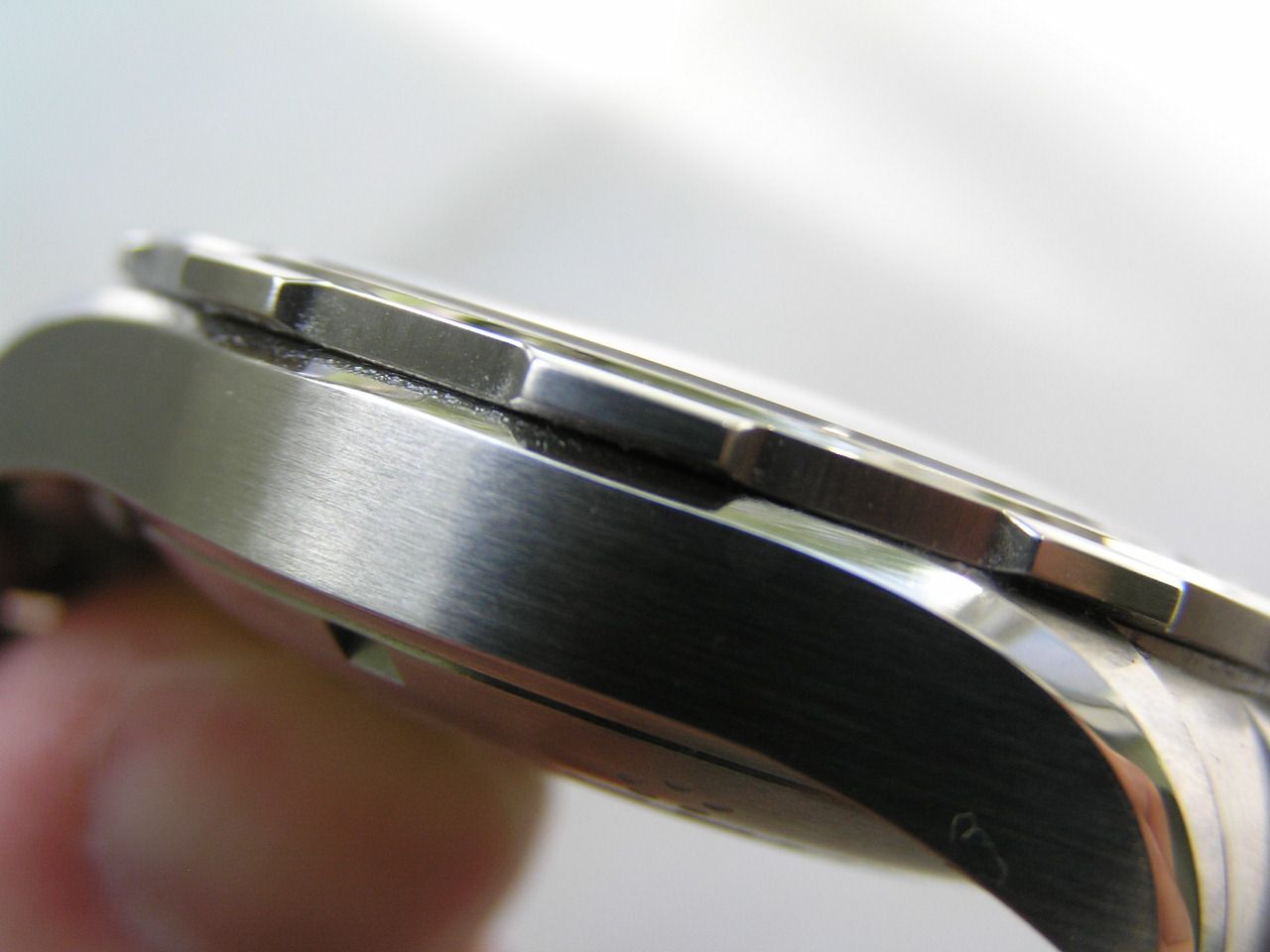
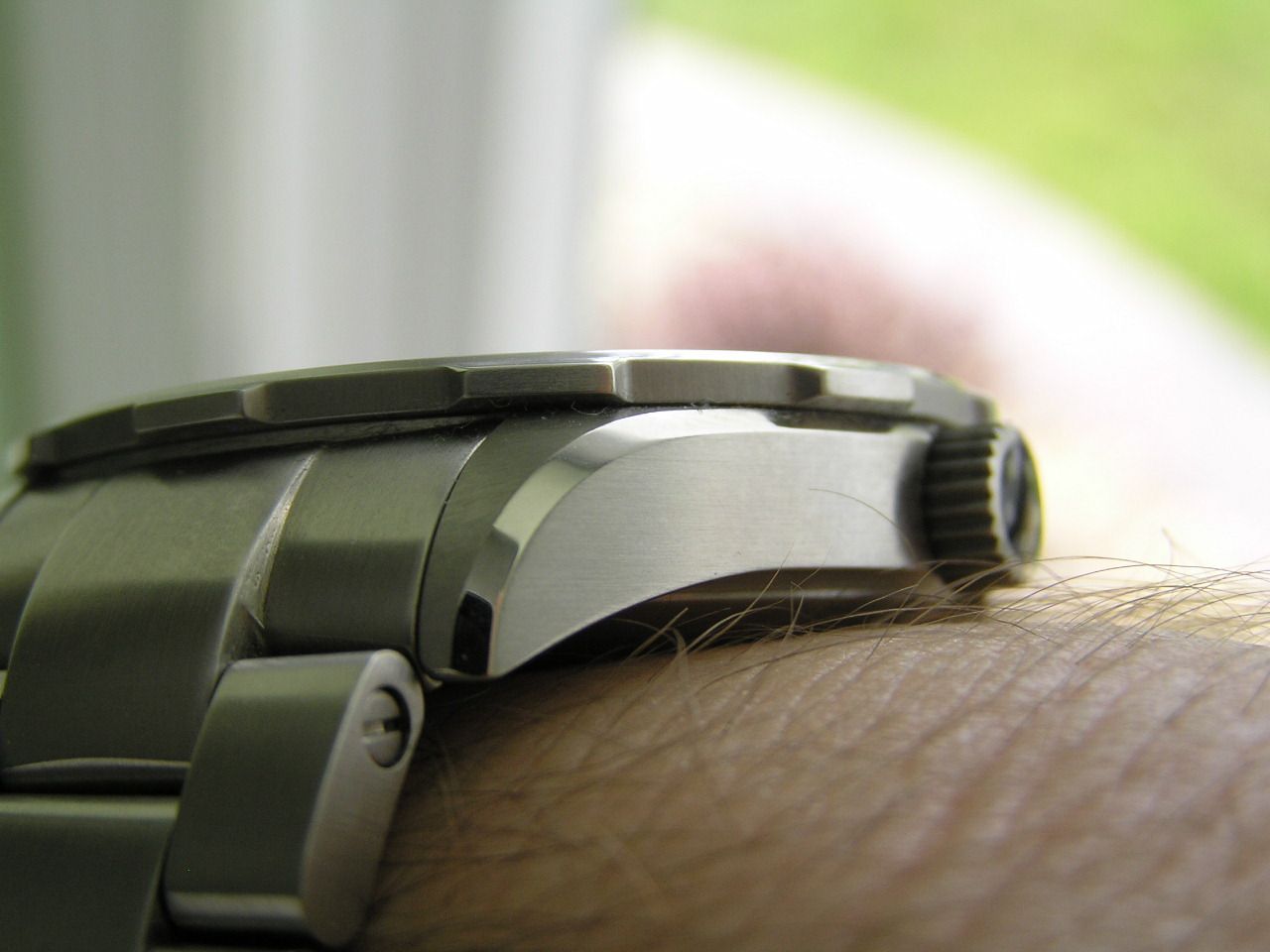
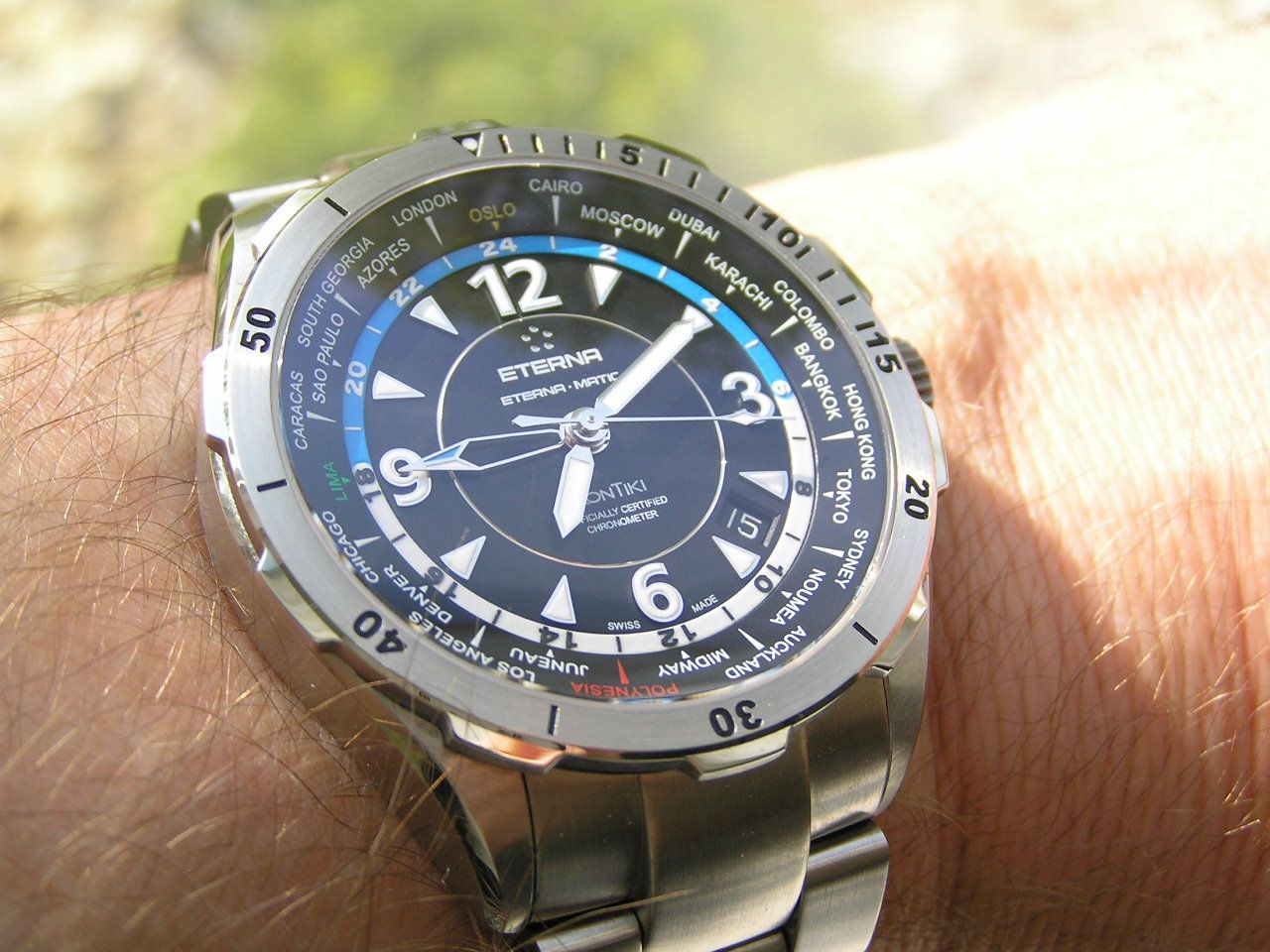
Robustly constructed of solid stainless steel with superb fit and finish, the Eterna KonTiki GMT starts with a brushed and polished case measuring 41.5mm without the signed, screwdown crown; 44.6mm crown inclusive.  The crown is appropriately sized, not too big but not too small and is signed with a black insert showing the five dot Eterna logo. 

Case thickness is 13.6mm, lug width is 22mm.  Although this watch measures almost 42mm in size, it does not wear that big, due to the world cities inner bezel, the outer timing bezel and the shortness of the hands all combining to make the dial smaller.

The caseback is brushed and screws down and is embossed with the super cool KonTiki logo, depicting Heyerdahl’s raft at sea, encircled by a thin polished ring.  It looks very nice.

The watch is factory rated for 200 meters of water resistance, which is fitting for a watch named after a rafting expedition.

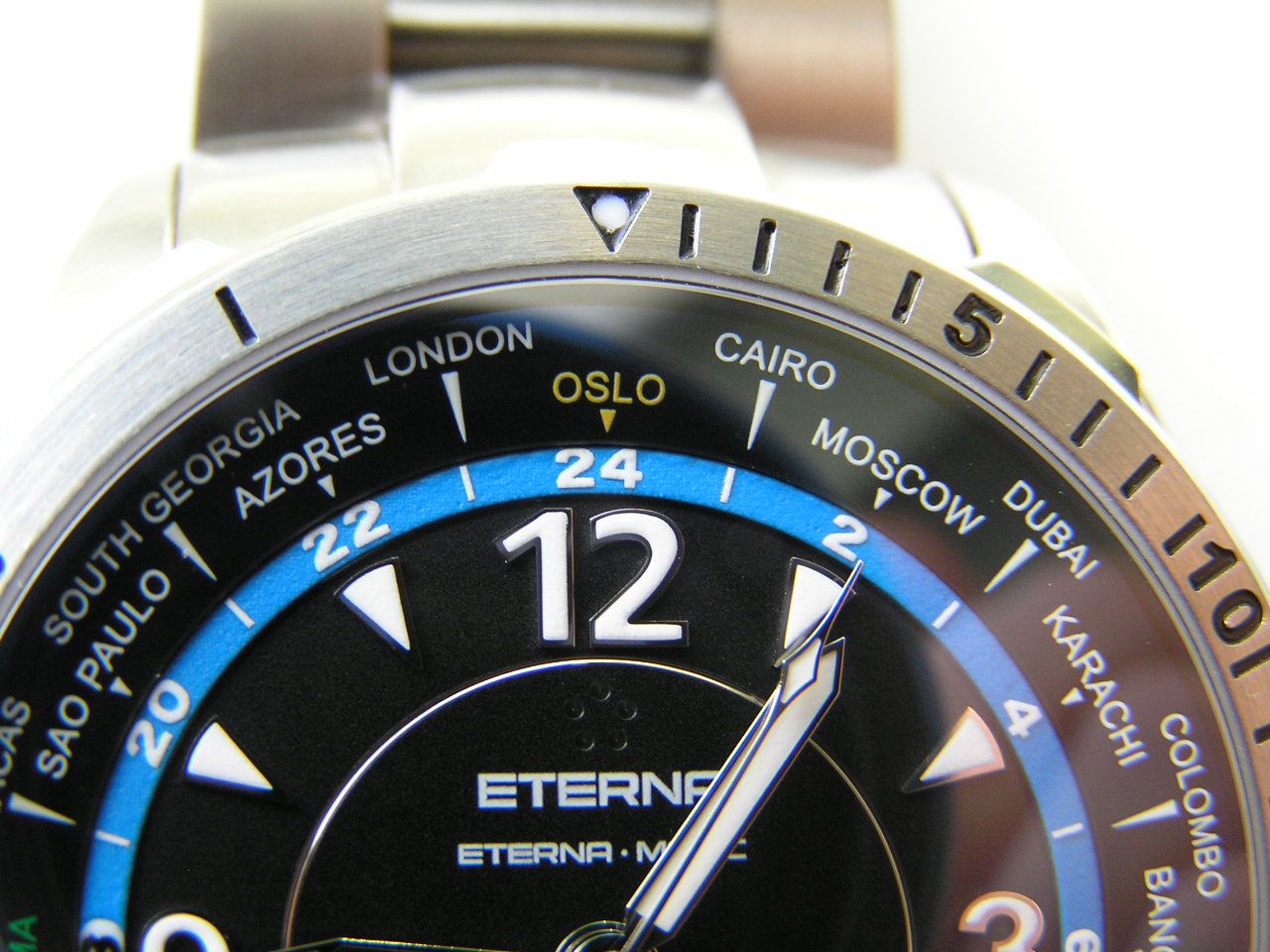
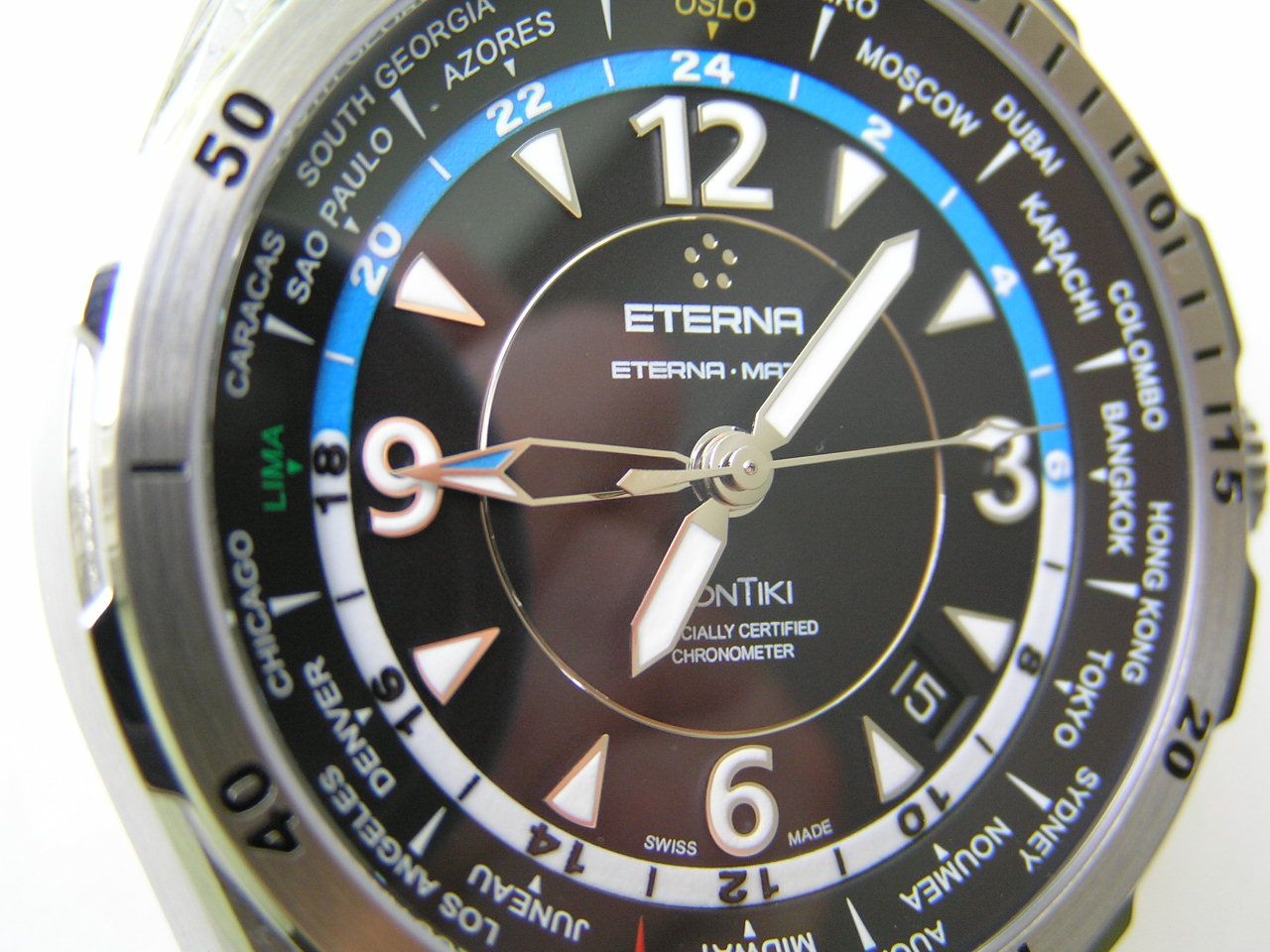
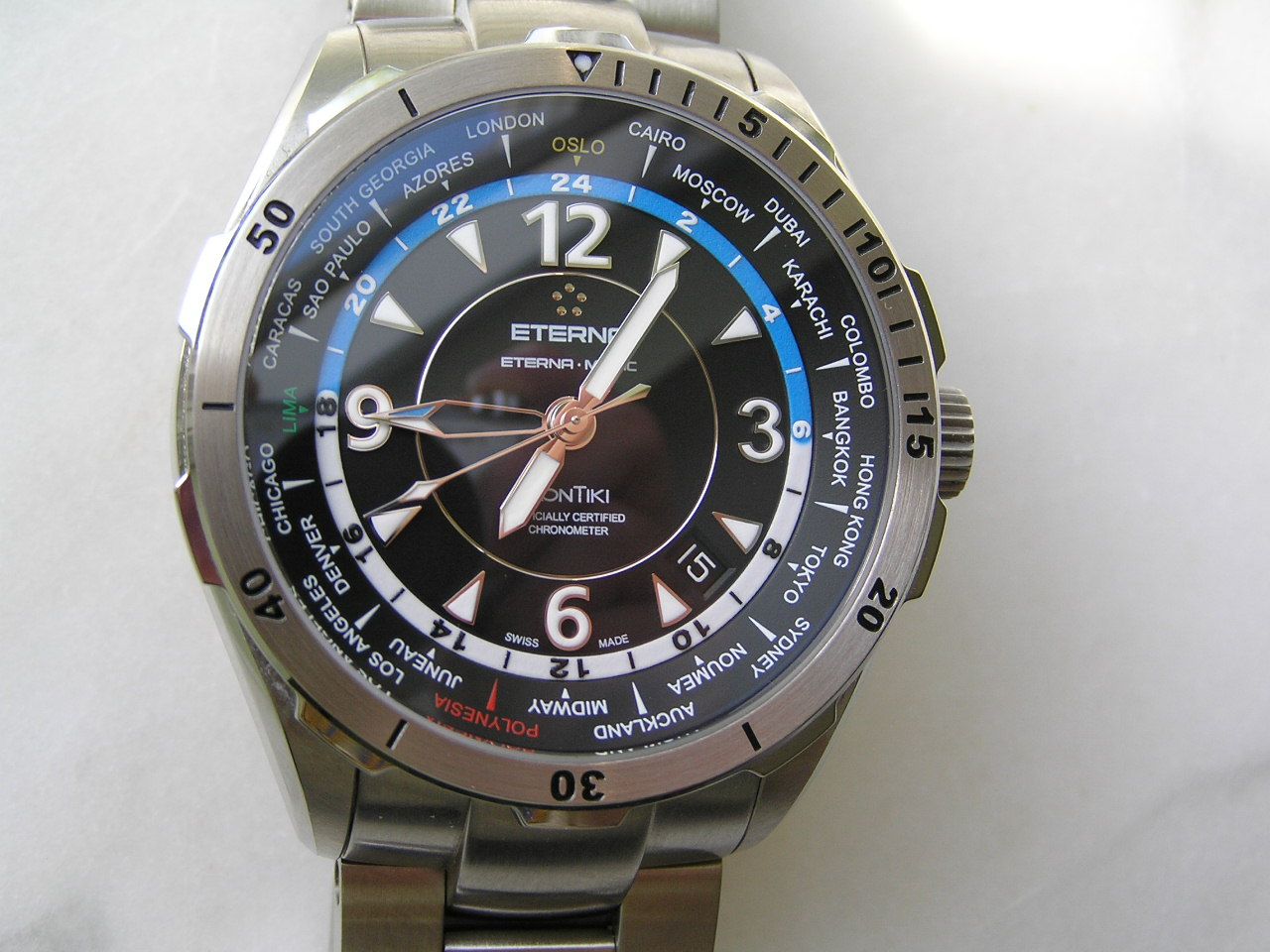
The dial of the KonTiki GMT is black, with a thin silver circle running along the inside of the applied luminous triangular or dagger-style markers.  Applied luminous arabics sit at each quarter hour, with the daggers filling the space between the quarter hours at each five minute mark.  There are no minute markers on the dial, which I find slightly disconcerting, for no other reason than it makes it hard to set the time exactly; you have to wait until it’s five or ten after, etc.

The hands are silver with inset lume and are rather short to me.  They don’t even reach to the outer edge of the 24-hour GMT chapter ring, but this is intentional, I’m sure, to make it easier to read the time in other locations and to no overpower the GMT hand.

The GMT hand is a skeleton style with a two-color pointed tip, half blue and half white, with the white part being a brighter luminous than the blue part.  A rather curious and odd feature if you ask me, but it matches the 24-hour chapter ring that is blue from 18 hours (6 p.m.) through 6 a.m.  The rest of the 24-hour chapter ring is white.  I think this is done to resemble a day/night sort of delineation. 

The 24-hour chapter ring is also luminous, with the upper half (the blue part) being not as bright as the lower half.  Overall lume quality on the KonTiki GMT is average, although the lume is a cool blue color.

The watch seconds hand is a thin silver stick with a lume tip a few millimeters down from the end.

The remainder of the dial on the KonTiki GMT is composed of the world cities bezel, which rotates around the outer edge of the dial.   There are 24 cities/locations listed, with Oslo in yellow, Polynesia in red and Lima in green, highlighting the cities and locations of Heyerdahl’s expedition.  I think the colors add a bit of pizzazz to the dial without looking garish.

The outer timing bezel is unidirectional and turns stiffly without any clicks.  It can be used for standard timing duties, with the first 15 minutes marked by black hash marks and a small lume dot at the 12. 

The timing bezel also is used to rotate the inner cities bezel.  Whenever the timing bezel is rotated, the cities bezel moves along with it.  This design is a bit cumbersome, but practical, because I always appreciate a timing bezel on a watch (and this is a feature that is not found on too many GMT watches) and it eliminated the need for a second crown to rotate the cities bezel. 

Eterna must also use some sort of slick gasket system between the bezel/crystal and case to allow for the outer bezel to rotate the inner bezel and to maintain 200 meters of water resistance.

The dial also has a quickset date window at 4:30 with a proper white on black date wheel that blends well with the rest of the dial.  The KonTiki GMT features a slightly domed sapphire crystal that fits perfectly flush with the edge of the bezel. 

Overall the dial is a bit busy, but is segmented enough to allow for standard timekeeping, GMT/24-hour indication and world timekeeping to be accomplished fairly easily.

The KonTiki GMT features an automatic Swiss Made ETA COSC-grade movement, which is nicely decorated and has an external dust cover/anti magnetic shield that sits between the caseback and movement.  The GMT hand is independently adjustable by rotating the crown clockwise in its first click position.  The GMT hand clicks into position in one-hour increments.  Running well within COSC standards, my KonTiki GMT has performed at +2/24 hours and turns in a strong 49-3/4 hour power reserve.

If you’re wondering why I know so much about what the movement looks like in this watch even though it does not have a display back, I will tell you.  When I received this watch (purchased brand new on the grey market) I set and wound the watch for initial testing in my workshop.  Shortly after I set it, I looked at it and realized the watch was not running!  I picked it up and heard an awful crunching sound.  I gently jostled the watch and it began to run again, so I set it down and let it run out its power reserve.

At this point, I had surmised the rotor has loosened up and was flopping around inside the caseback.  I don’t crack the back on brand new watches, but not wanting to return it either, I brought the watch to my trusted watchmaker.  He opened up the back, removed the movement shield and promptly discovered that one of the screws and clamps on the movement holder securing the movement to the case had come undone.  He fished out the errant screw and clamp, resecured them and gave the other screws a once over.  Everything has been fine since then.

So this is the only slight I will give Eterna regarding the quality and workmanship on this particular example of the KonTiki GMT.  The watch otherwise has been fine, the fit and finish is very good, so I chalk up this one loose movement screw and clamp as ‘just one of those things’ and have moved on.

The bracelet is superb on the Kontiki GMT, with solid, thick links (3.6mm), solid end links and a very attractive signed pushbutton clasp with machined deployant and diver extension.  The clasp is the exact same design (and presumably the same maker) as the clasp on the Ulysse Nardin Maxi Marine Diver, a watch that retails for twice what the KonTiki GMT does.

The bracelet is fully brushed and measures 22mm at the watch head and tapers to 20mm at the clasp.  Adjustment is by thick screw pins, the kind that require a screwdriver to be held on each end in order to tighten or loosen.  A bit awkward, but quality nonetheless.  There are no microadjustments on the clasp, but half links are provided on the bracelet on both sides, so a pretty good fit can be expected.

Presentation with the KonTiki GMT is top-notch.  A two piece cardboard outer box reveals a large, beautifully lacquered wooden box with the KonTiki logo medallion on top.  The box opens to reveal the watch, extra signed rubber strap and a plastic accessory compass, plus the instruction manuals and warranty paperwork.  Extremely classy and befitting a storied watch such as the KonTiki.

Overall, the Eterna KonTiki GMT/World Timer is a unique, functional and solid watch that gives the user a quality timepiece with a bit of history behind it.  It’s an all-around good looking solid performer at a very competitive price.

Pros:  superb all-around construction, COSC automatic movement, great bracelet and clasp, GMT/World Time functionality

Cons:  lume could be stronger, hour and minute hands a bit short in relation to the dial, no minute markers on the dial, QC glitch with loose movement holder screw and clamp

Verdict:  an outstanding value in a Swiss-Made GMT/World Timer with great features, great quality and a storied name by a storied Swiss house.  Snatch one up before they are forever sold out!

Thanks for reading and enjoy the pictures.

Excelsior!

-Marc