Saturday, April 19, 2014

Review of Tudor Heritage Black Bay

Model # 79220R

Brand/Model:  Tudor Heritage Black Bay Automatic
Movement:  Swiss automatic
Material:  stainless steel case, distressed-style vintage leather strap
Complications:  none
Price:  MSRP $3,100 USD


Plenty of photos follow the review. Click on the pictures to enlarge.

The Tudor Heritage Black Bay pays homage to the company’s diving watches that appeared in 1954 and that continually evolved into the 1980s.  The new Tudor Heritage Black Bay was introduced a couple of years ago to great acclaim and rightfully so, this is a superb watch.

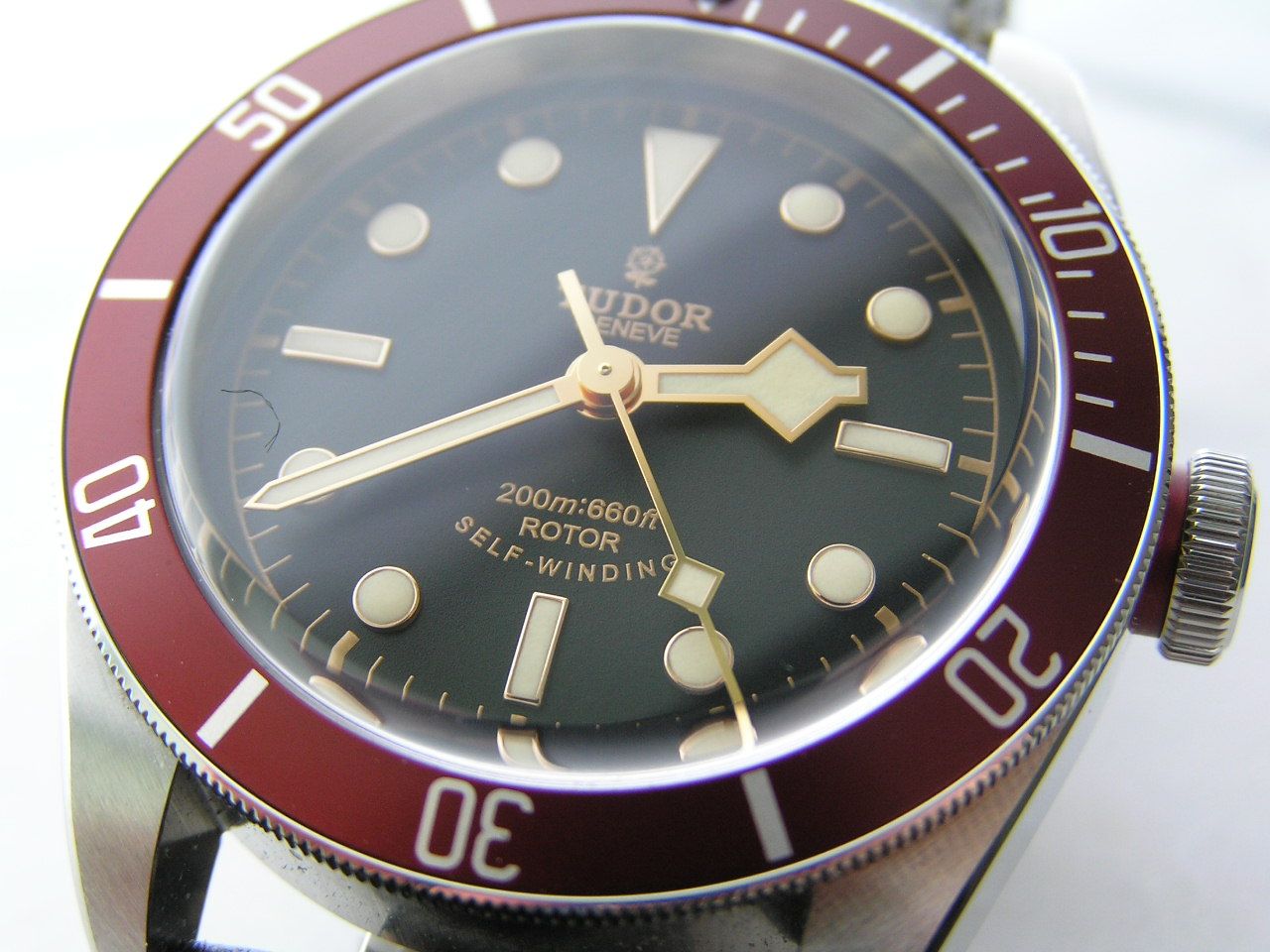
The modern Black Bay features gold tone hands and markers, harkening back, as Tudor says, to the ‘characteristic patina of older timepieces.’  According to the company, the beautiful burgundy red on the bezel is an original feature exclusive to Tudor and is faithful to their original 1970s models.

The Black Bay comes on either a stainless steel bracelet or a wonderful looking distressed-style vintage black leather strap.  Both variations also come with an extra black fabric strap.

Also introduced this year at Baselworld 2014 is a new blue Black Bay, with a stunning blue bezel and silver tone hands and markers replacing the gold tone pieces on the burgundy Black Bay.  The new blue model features a blue fabric strap in addition to a leather strap or stainless steel bracelet.

The Black Bay starts with a polished and brushed stainless steel case measuring 41mm without the large signed screwdown ‘big crown’; 44.6mm crown included.  Case thickness is 12.8mm; lug spacing is 22mm.

The crown tube is crafted in red anodized aluminum, which is visible between the case and crown.  The crown is polished and carries the Tudor ‘rose’ logo infilled in black.

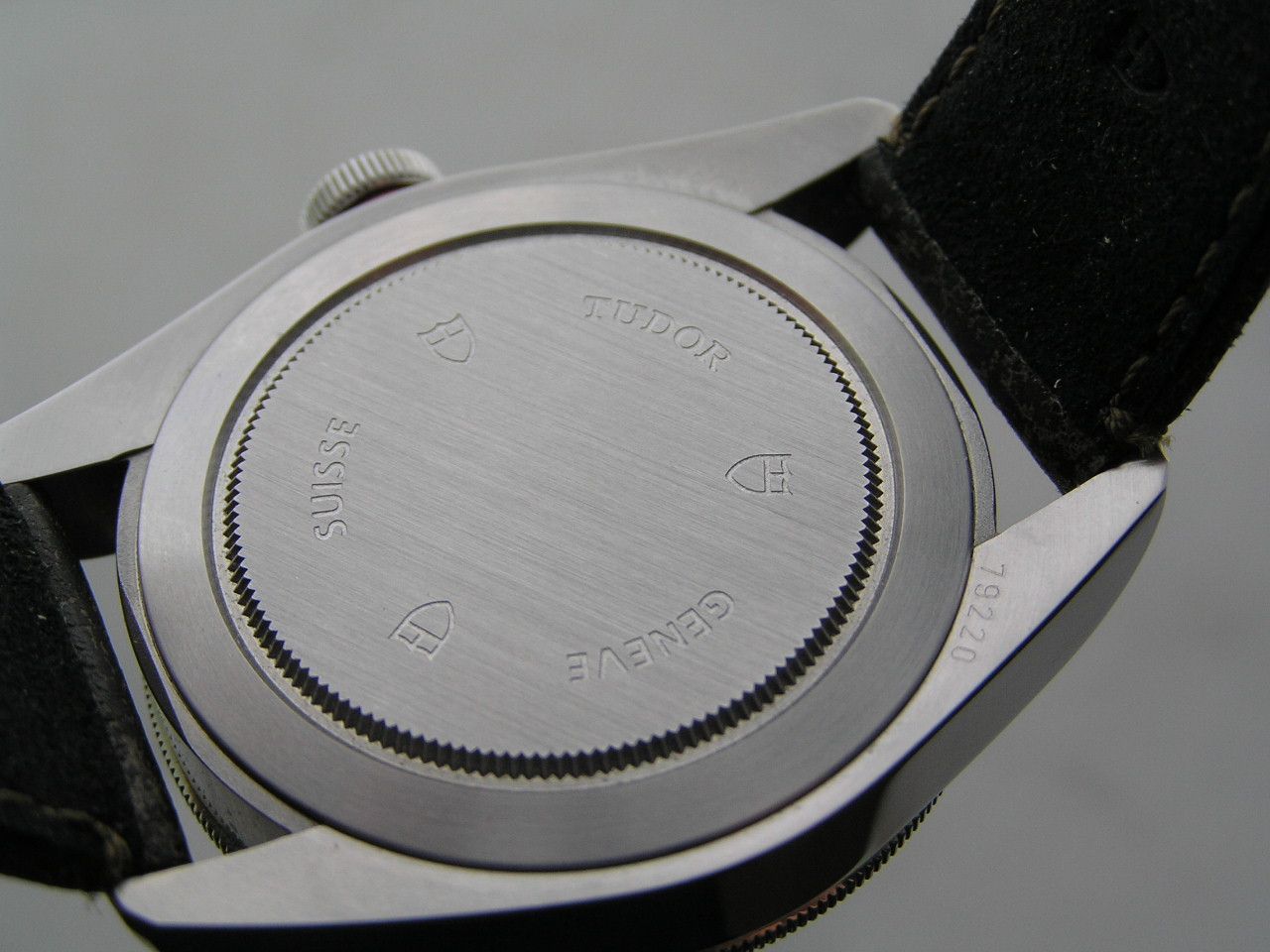
The caseback is fully brushed and fits nearly flush with the case itself, a signature feature of many Tudor watches.  The caseback screws down and is minimally adorned, with just the Tudor name, several small Tudor logos and the words ‘Suisse’ and ‘Geneve.’  Minimalism at its finest.

Overall fit and finish is what you would expect from Tudor, that is, great in all respects.  No sharp edges, nothing misaligned or dirty.  Just quality all the way.

Being a dive watch, the Black Bay is factory rated at 200 meters of water resistance.

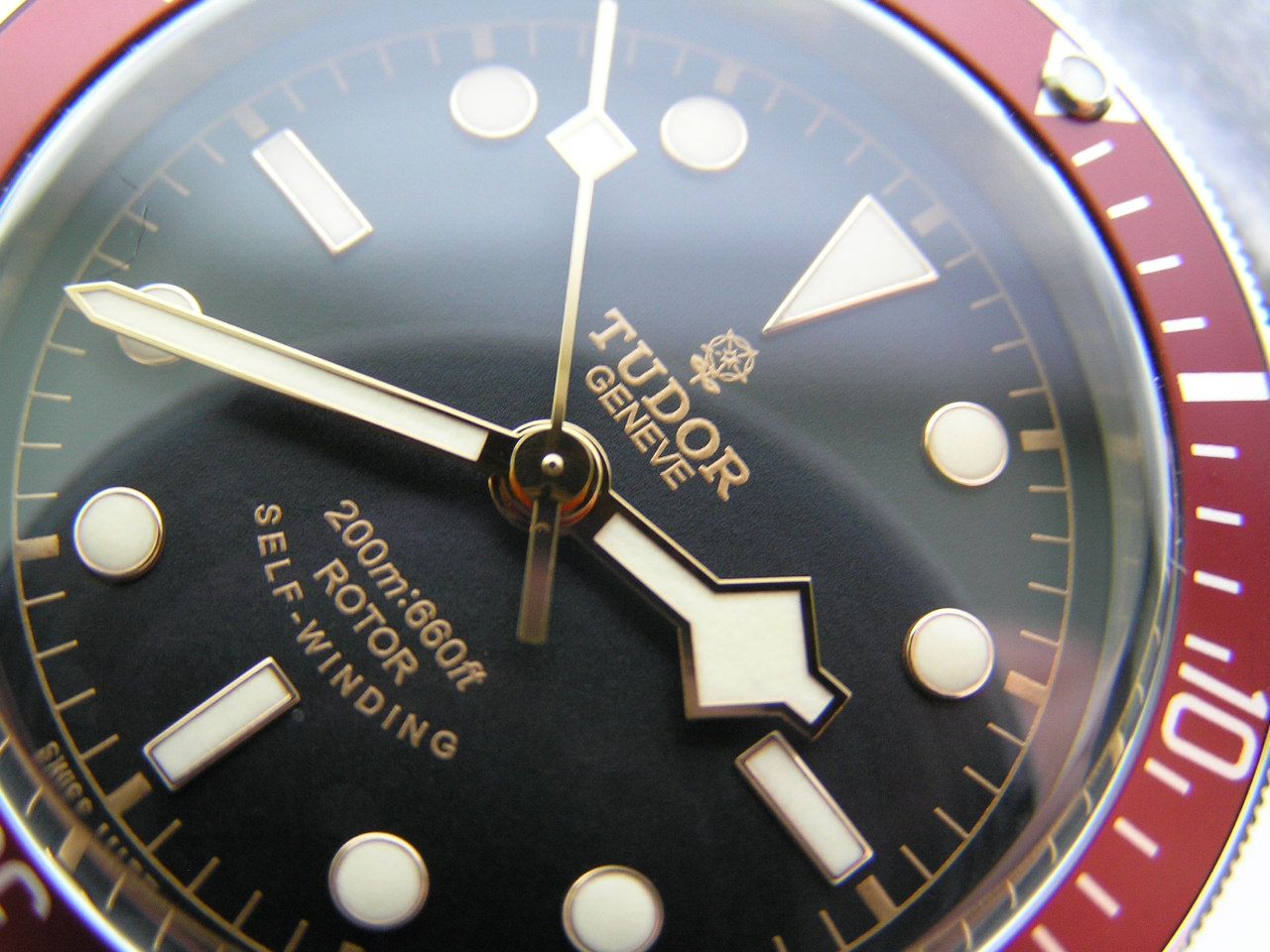
The dial on the Black Bay is a matte black, with applied gold markers infilled with lume.  The marker at the 12 position is an inverted triangle, with the markers at the quarter hours being rectangular while the remaining markers are round.  A gold minute track encircles the dial at its outer edge.

The hands are the famous Tudor ‘snowflake’ design, with the hour hand featuring the iconic snowflake shape, with the minute hand a simple pointer-style stick.  The seconds hand has the snowflake diamond about two-thirds the way up its gold tone shaft.  All of these hands are gold with inset lume.  Lume quality is excellent:  bright, long-lasting and evenly applied.

Below the 12 marker is the Tudor rose logo rendered in gold, along with ‘Tudor’ and ‘Geneve’ below it.  Above the 6 marker are ‘200m:660 ft’, ‘rotor’ and ‘self-winding.’  The use of ‘self-winding’ instead of the modern term ‘automatic’ is Tudor’s way of staying retro with this watch.

The burgundy bezel is a 60-click unidirectional type, with minute markers for the first 15 minutes and arabics or markers every five minutes afterwards.  Bezel action is crisp and has a nice, solid, yet slightly cushioned feel to it.  The edge of the bezel has a fine coin edge finish.  A lume pip at 12 adds functionality.  Oh, and in case you’re wondering, the burgundy color is simply smashing!

Capping the dial is a domed sapphire crystal with no distortion or defects noted. 

One thing that makes the Black Bay such a winner is its simple, no-fuss design.  The dial is clean, easy-to-read and highly functional.

Inside the Black Bay is an ETA 2824 Swiss Made automatic movement.  Running in 25 jewels at 28,800 bph, this workhorse of a movement is familiar to practically all watch enthusiasts. 

While some people decry a ‘plebian’ ETA  movement inside a Tudor, there is absolutely nothing wrong with this movement in a watch of this caliber.  First off, many many luxury watches sport ETA or ETA-based movements, not true in-house calibers.  Secondly, it would make little sense for Tudors to use Rolex movements.  Why put a Rolex movement in the brand’s secondary lineup?  Not gonna happen.  Third, Tudor uses the high-grade version of the 2824 and this movement is easily capable of running within COSC specs when properly regulated.

That being said, the performance of my Black Bay is completely acceptable, although not quite running at COSC spec., but remember, this watch is not COSC certified.  Its performance of about +6 to +7 seconds over 24 hours is fine and as I stated, any competent watchmaker can regulate that down much finer.  Power reserve is the expected 41 hours.  Winding, hacking, setting and crown functions are perfect.

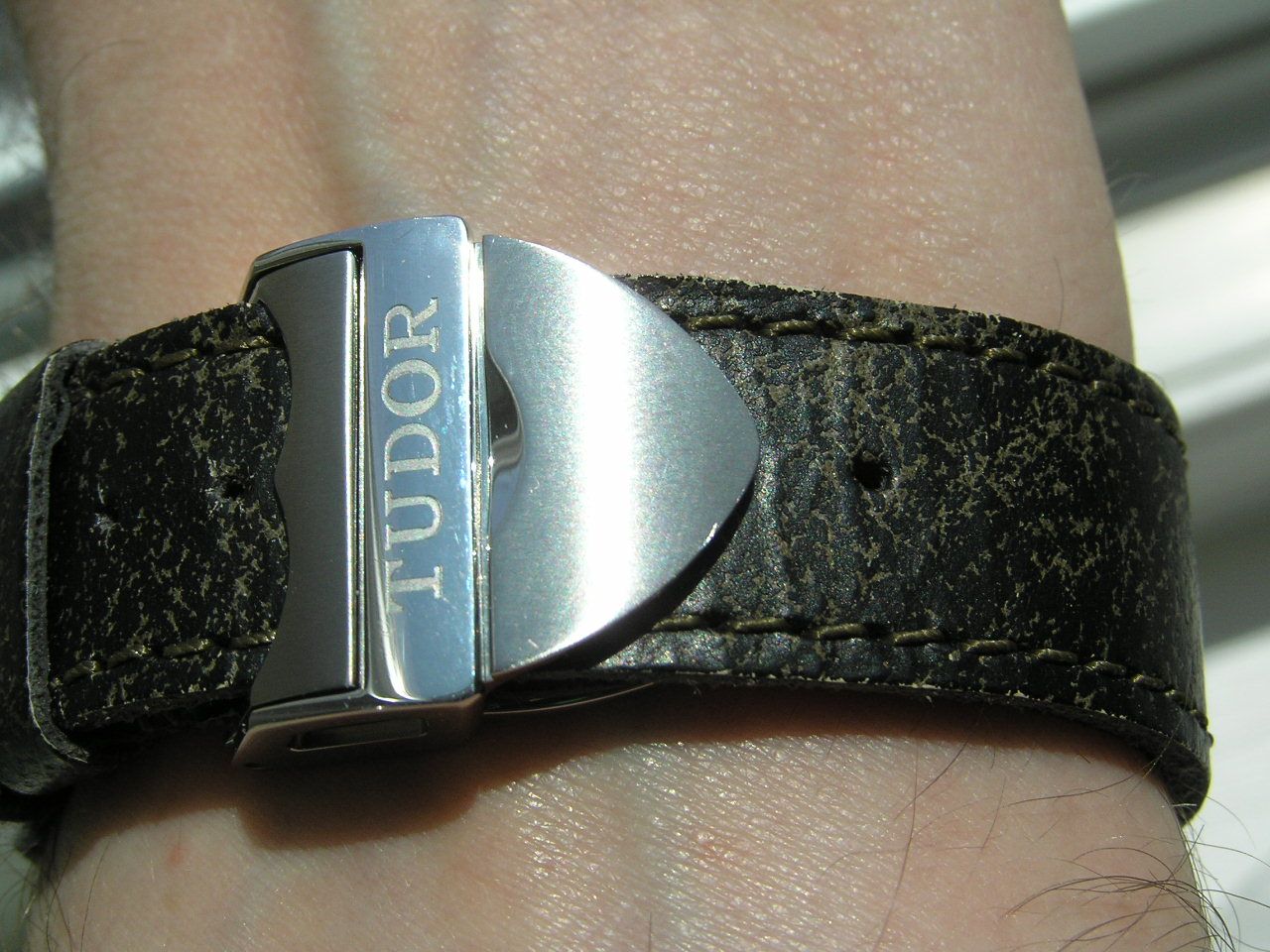
The black vintage leather strap on the Black Bay really sets this watch apart.  The look is absolutely perfect for this watch.  Not forced in anyway, this strap exudes ‘retro’ without yelling it, says ‘sophisticated’ without any shine and feels great on the wrist.  The inside of the strap has a suede-like finish, while the outer distressed portion is matte finished with same-color stitching.

The strap measures 22mm at the lugs and tapers to 17.7mm at the clasp.  There are two keepers, one fixed and one floating.  The clasp is polished and brushed and is signed, with a pointed fold-over safety tab.  The deployant is a fully polished high-quality stamped piece of stainless steel, while the clasp features small white ceramic friction bearings for a tight fit and long life.  Quality through and through.

Presentation is via a two-piece outer box in dark brown with a polished black inner box containing the watch, the additional black fabric strap and papers, which are placed in a red wallet-type holder.

Overall, the Tudor Heritage Black Bay is a respectful look back at various iconic Tudor watches, with enough modern touches to make it a contemporary timepiece suitable for many activities. 

The simplicity of the watch (no date display) makes it a perfect ‘grab and go’ watch that is functional, fashionable and still unique enough to say ‘I have arrived.’  Perhaps the perfect homage to Tudor’s proud horological heritage.

Pros: simple, functional, attractive design, high-grade Swiss engine, superb fit and finish, outstanding vintage leather strap

Cons:  should case be fully brushed instead of polished? lack of a date display could affect some buyers, still pricey

Verdict:  an out-of-the-box hit for Tudor, the Heritage Black Bay combines many classic Tudor touches with enough modernity to create a watch that’s perfectly at home in today’s busy world.  An outstanding achievement!

Thanks for reading and enjoy the pics.

Excelsior!


-Marc


Tuesday, March 18, 2014

Review of Fortis B-42 GMT/Chronograph Automatic


Model # 643.10.172 (discontinued)

Brand/Model:  Fortis B-42 GMT/Chronograph Automatic
Movement:  Swiss automatic
Material:  stainless steel case and bracelet
Complications:  date display, 24-hour GMT hand (independently adjustable), chronograph timing in one-second increments up to 12 hours
Price:  MSRP around $4,500 USD (when sold new, now discontinued)


Plenty of photos follow the review. Click on the pictures to enlarge.

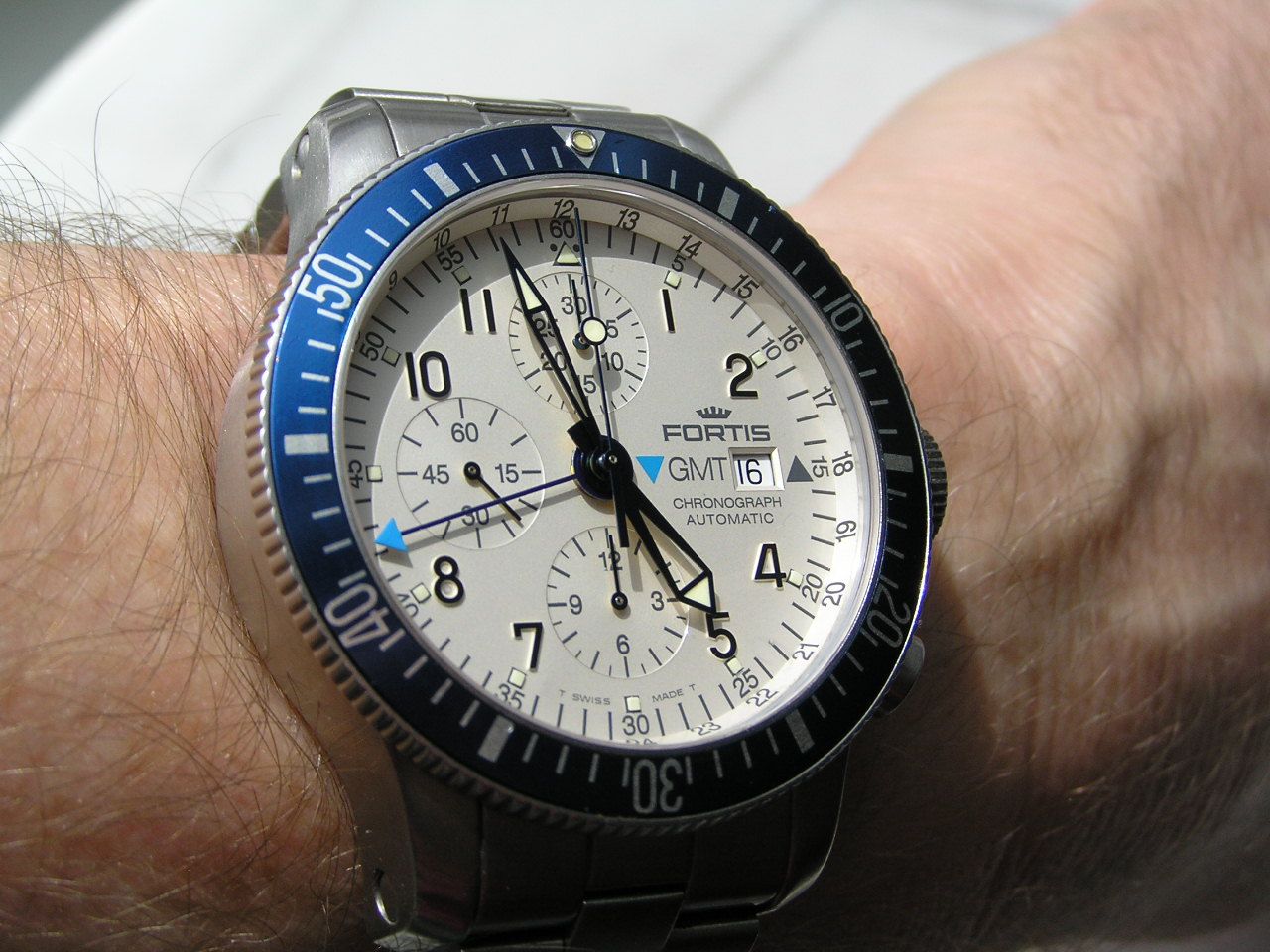
This Fortis B-42 GMT/chronograph automatic may look familiar to regular readers of this blog, as it was featured as the main page photograph for a good many months.  People really seem to react to the look of this watch, with its stunning blue hands and blue bezel, it is hard to resist.  Even though this watch is now discontinued, I’ve been wanting to review it, because it is a superb piece and Fortis does make similar models now.  This also happens to be a very photogenic watch, so please enjoy the pictures!

The B-42 line from Fortis is quite varied, with standard and chronograph models both available, along with alarm and GMT complications.  This particular B-42 GMT/chronograph is a very rare piece; it was offered in the silver/white dial with blue hands both with and without the rotating bezel.  I believe the model being reviewed here is the rarer of the two.

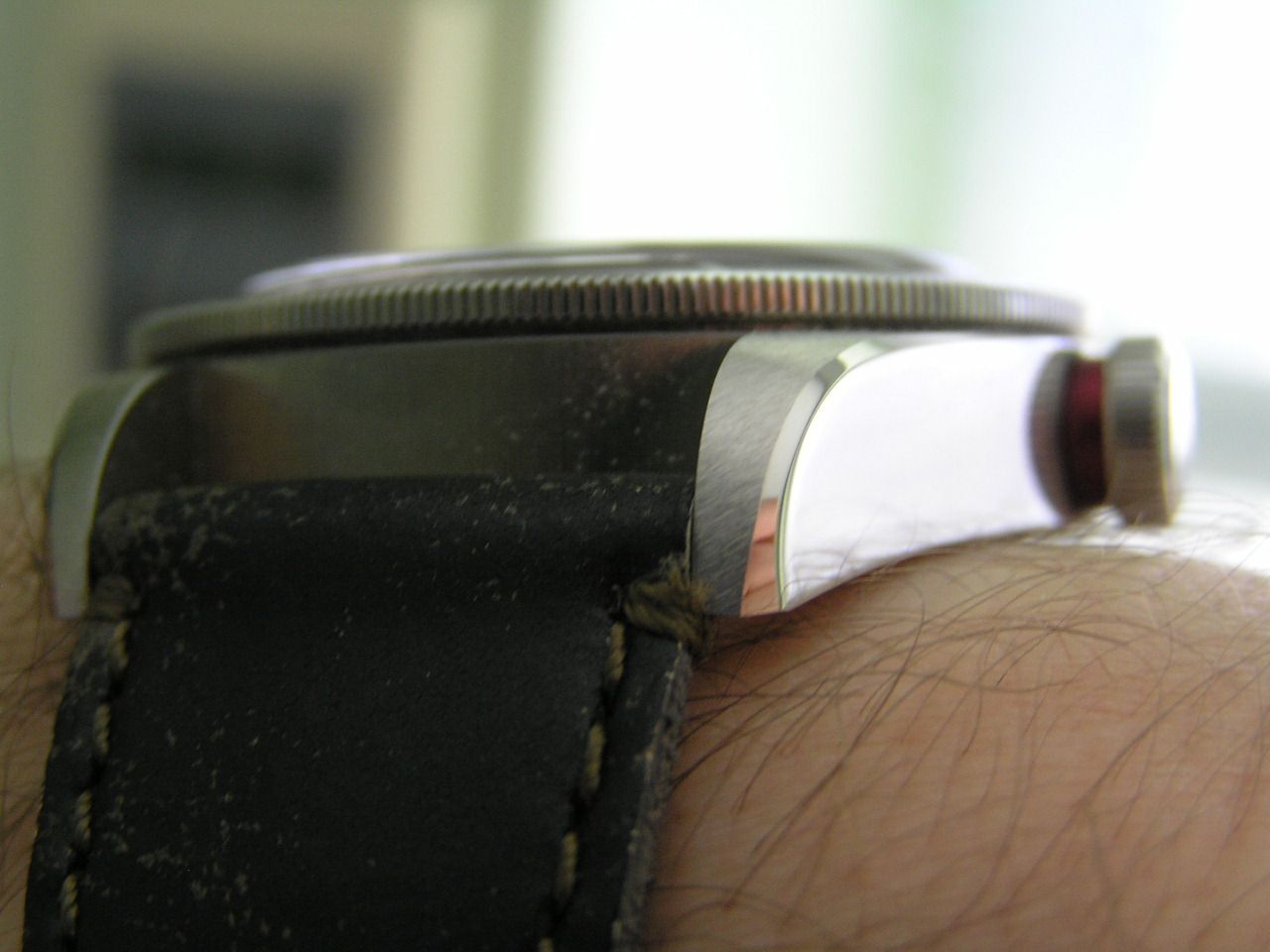
For starters, this is a heavy and substantial watch, which is fine, but be forewarned if you dislike big stainless steel chunks sitting on your wrist.  The all stainless steel case is finely brushed and lends a nice tool-like look to this watch.  The case measures 44mm without the large, signed and non-screw down crown; 48.1mm crown included.  The crown itself measures 8.4mm in diameter.  Although these dimensions sound large, the watch does not wear overly large nor does it look clownish on the wrist.  This is partly due to the relatively short lugs, with a lug-tip to lug-tip measurement of just 52.6mm.

Lug spacing is 20mm, case thickness is 15.4mm.  While 20mm lugs may sound dainty on a 44mm sized watch, the bracelet is a continuous width design and fairly chunky, so it matches the size and heft of the watch well. 

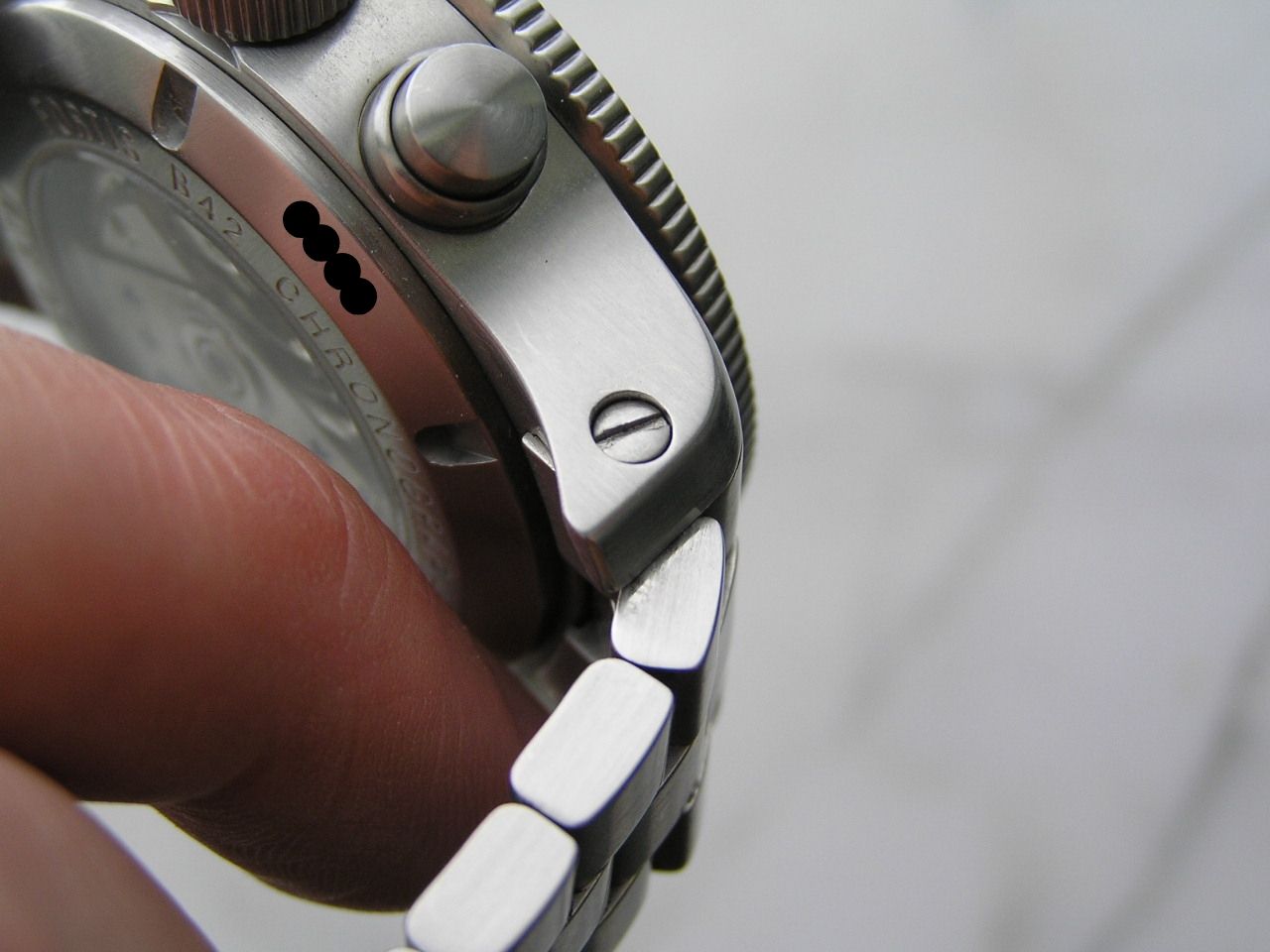
The caseback is a screwdown display type that shows off the automatic movement with signed Fortis rotor with blue accents.  Fairly nifty. 

Build quality is generally good, along with fit and finish, but I do know some owners of this watch that have had the blue finish on the arabics start to deteriorate.  Mine is fine thus far.

This B-42 GMT/chronograph is factory rated for 200 meters of water resistance and does so without a screwdown crown.  Many people think a screwdown crown is a necessity for water resistance (especially at this depth) but the main function of a screwdown crown is to insure that the crown does not get pulled out, thus stopping the watch during an underwater maneuver.  Gasket design, construction and utilization make a watch water resistant and I have no doubt this Fortis would survive the wet and wild depths without any problems.

The chronograph pushers are large and round, which makes them easy to use.  Overall, there is nothing superfluous about the construction of this watch, it all makes sense and looks good doing it.

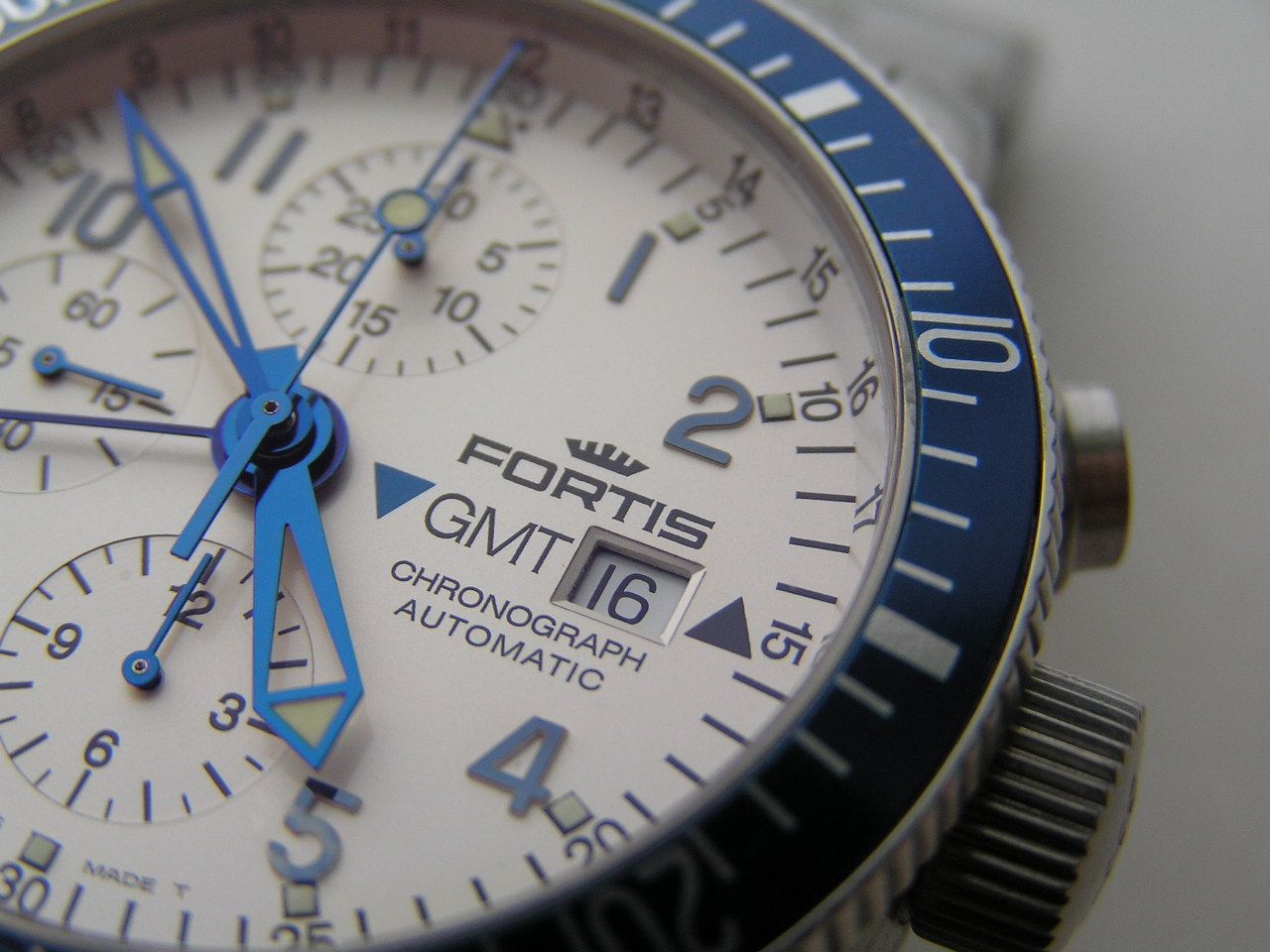
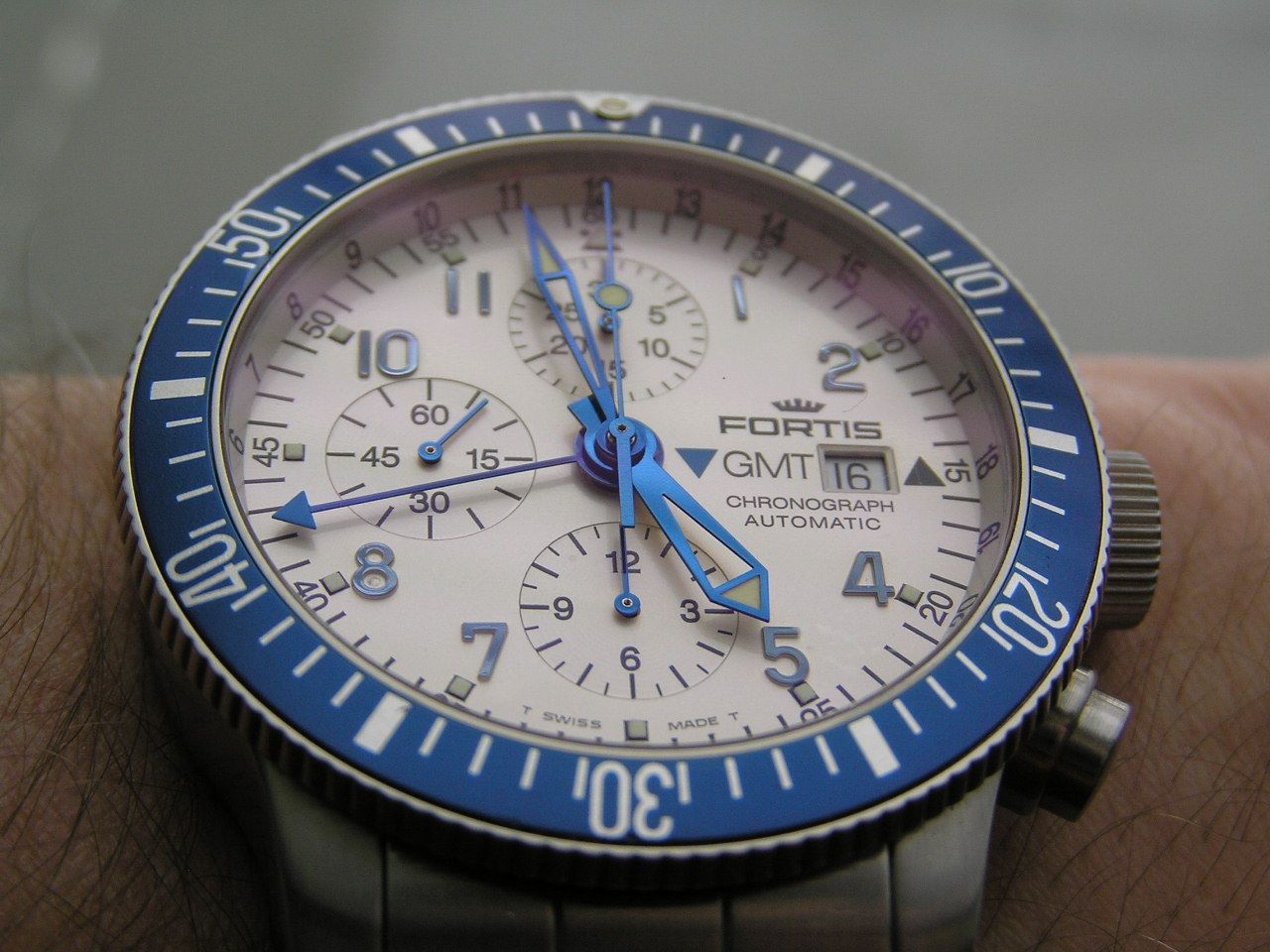
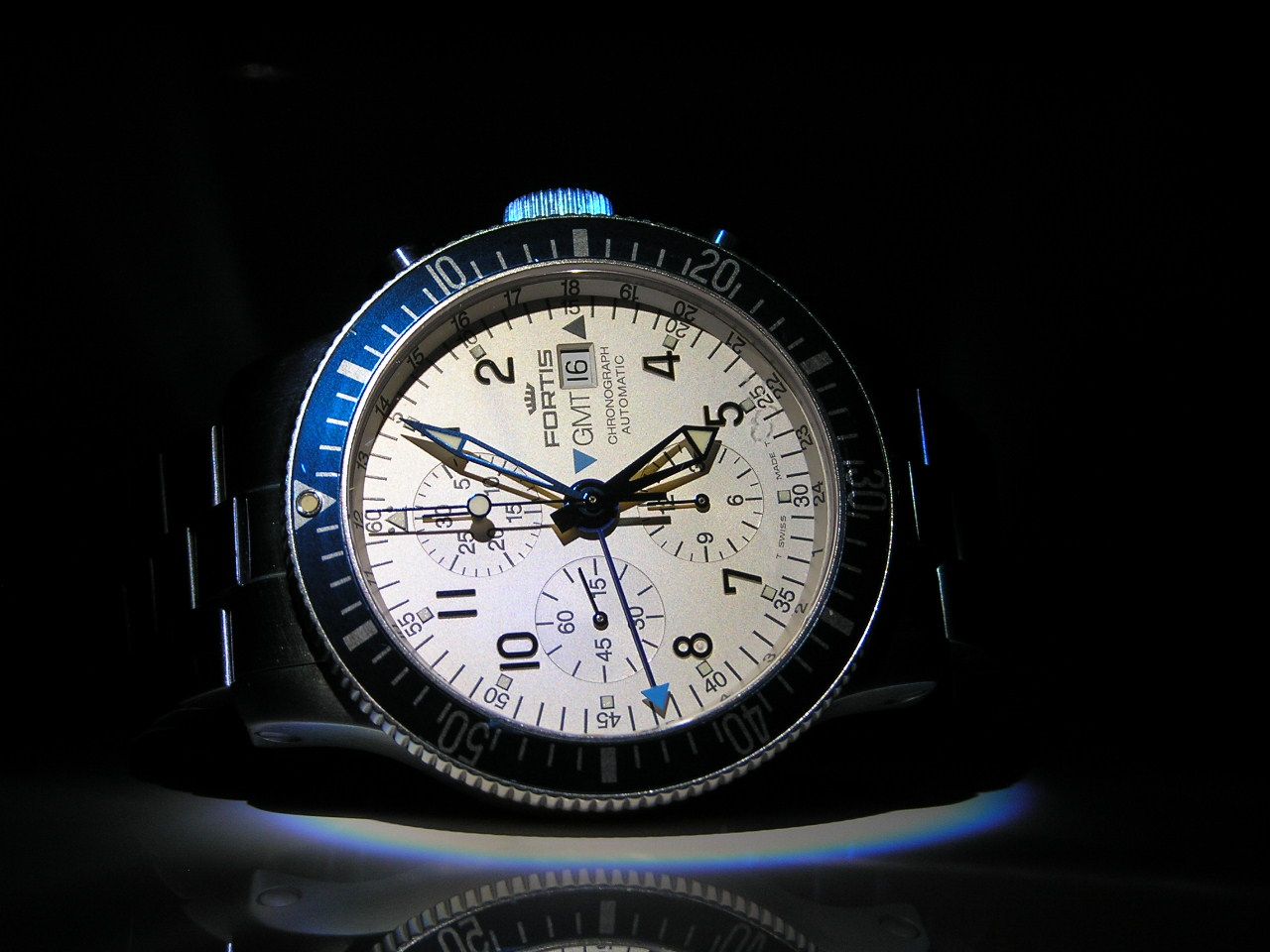
The dial is a light silver which trends towards white in most light.  It offers a nice contrast to the blue applied arabics on the dial, along with the blue hands and blue bezel.  The hour and minute hands are blue skeleton type, with luminous pointer tips.  The 24-hour GMT hand is a simple black stick with a pointer tip in a lighter shade of blue. 

The subdials on the watch (subdial at 9 is the watch seconds hand, subdial at 12 is the 30-minute chronograph totalizer and the subdial at 6 is the chronograph 12-hour totalizer) are ever so slightly recessed on the dial and are presented with simple black printing with blue hands.  The chronograph seconds hand is blue with a lume dot about two-thirds of the way up its shaft.

There are small square lume blocks at each five minute mark on the dial and a lume triangle at the 12 position.  Although the lume on this watch is rather sparse, it does a decent job; I rate the lume as ‘good’ according to my unofficial lume-o-meter (my eyes).

Minimal dial printing (always a good thing to me) consists of the Fortis name and crown logo just above the date window at 3, a printed ‘GMT’ to the left of the date window and very small wording below the date window of ‘chronograph’ and ‘automatic.’

A couple of notes on the dial.  A quickset date is at the three position, with a standard black on white date wheel.  Alignment of the date wheel within the window is good.  To the right of the date window is a black triangle pointer and to the left of the GMT printing is a blue triangle pointer. 

Fortis had the foresight to use these pointers as a reminder which way to turn the crown to set the appropriate complication.  In this case, turn the crown clockwise in the first-click setting position to set the date and turn the crown counter-clockwise in the first-click setting position to rotate the 24-hour GMT hand to the desired timezone position.

The arrows are a nice touch, especially since 7750-based GMT watches work opposite of a standard ETA 2893-1 GMT movement, where the GMT hand is set by turning the crown clockwise and the date is set by turning the crown the other way.  This is primarily because the 7750 was not designed to be a GMT movement, but can be used as a GMT by removing the day wheel complication and replacing it with a GMT hand.  A simple and effective way to gain GMT functionality.

The other item of note on the dial is the way Fortis decided to present the GMT format.  Instead of having the 24-hour chapter ring run from 1 to 24 hours starting at the 12 (or midnight) position, they have made the chapter ring run from 12 to 24 hours from the 12 to the 6 position and 1 to 12 hours back from the 6 to the 12 position.  This countdown style may be a preferred method for some pilots or ship captains, although I really don’t know.  Of all the GMT watches in my collection, this is the only one that presents the 24-hour GMT track in this fashion.

There are also small black minute arabics just inside the 24-hour GMT track, with plain black markers for the remainder of the minutes.  The small minute arabics tend to compete with the GMT hour markers, because they are the same size and color.  A bit distracting at first and not a huge error, but something worth mentioning anyway.

Topping the dial is a flat sapphire crystal with anti-reflective coating.  The beautiful blue bezel is a 120-click unidirectional style with a lume pip at the 12 and standard markings; arabics every 10 minutes with hash marks for the other minutes.  The bezel is easy to rotate but does has a bit of backlash.

Overall, the dial, while conveying a lot of information, is a clean and easy-to read layout.  The chronograph seconds hand is a bit hard to see at times if you’re not tracking its movement by its lume ball, but otherwise, I have no real complaints about the dial.  And with all the blue hands, it looks absolutely stunning.

Inside the B-42 GMT/chronograph is the well-regarded Valjoux 7750 Swiss Made automatic chronograph movement, modified for the GMT complication as mentioned earlier.  All functions on this watch (chronograph start/stop/reset, GMT hand setting, date setting, winding, etc.) all work well.  Of course, the movement hacks and manually winds (easy to do with the large crown) and runs extremely well in this example.  Power reserve is a good 49-¼ hours and accuracy has been measured at plus or minus a couple seconds a day both on and off the wrist.

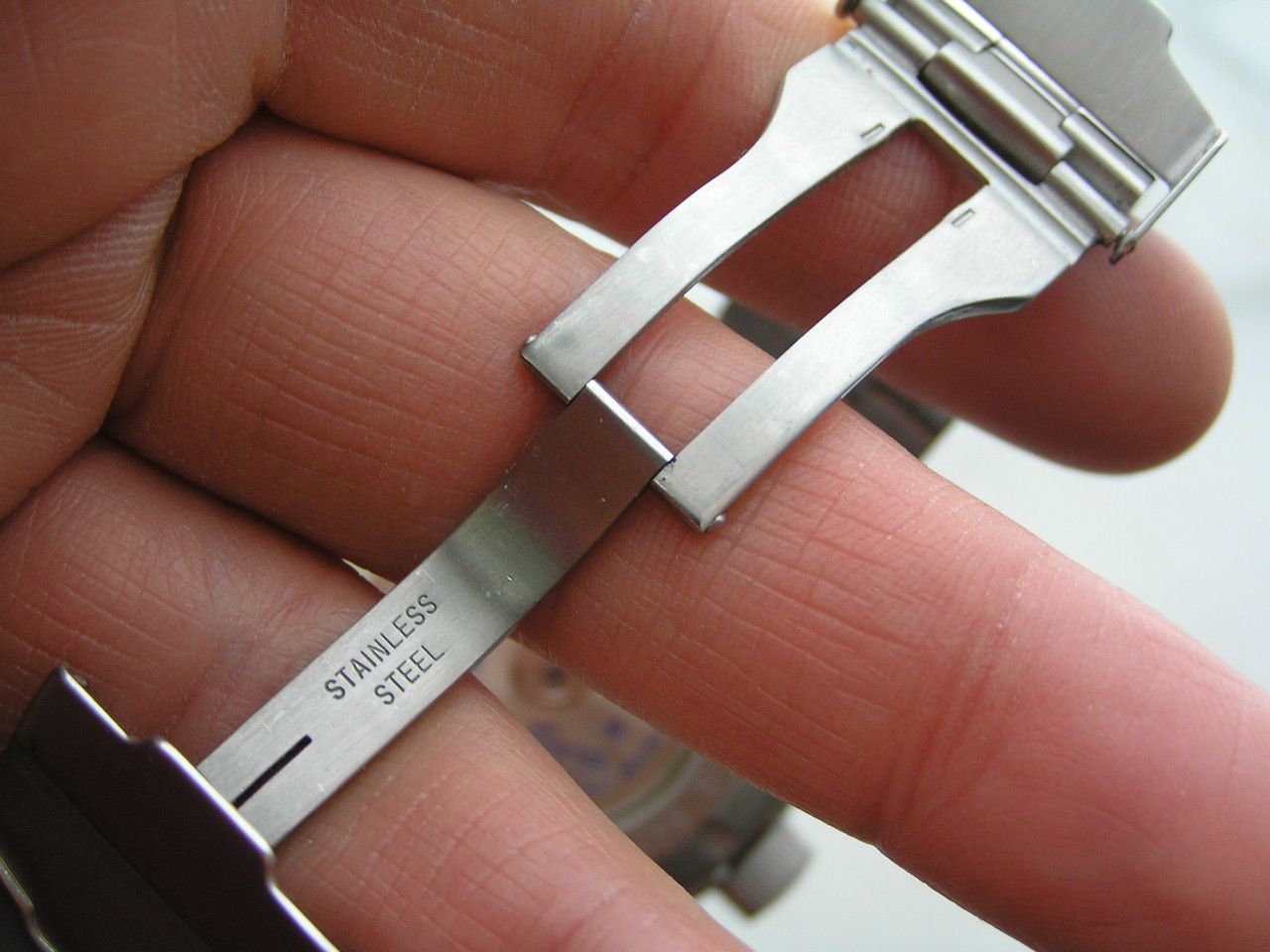
The bracelet is very nice on this B-42.  It is a fully brushed, solid link stainless steel design with solid end links, a signed double locking clasp with machined deployant and a stamped steel dive extension.  There are five micro-adjustments on the clasp and since the links themselves are rather narrow, there is no need for any half-links.

The bracelet measures 20mm at the lugs with no taper to the clasp.  Two things I love about this bracelet are the easy to adjust links with screwbars and a screw on one end and the awesome screwbar arrangement that secures the bracelet to the watch head. 

As many of you know, removing or installing a bracelet on a watch that uses standard spring bars can be a temper-testing exercise.  Fortis uses robust screw bars that can only be inserted one way into the watch lugs and it is a cinch to insert these bars through the bracelet ends and secure the bar with the large end screw.  Very slick!

While this B-42 model is discontinued, it is well worth seeking out.  It combines no-nonsense tool watch personality with superb functionality and a great look (gotta love that blue!) that will make it a star in any collection.  A real winner from Fortis, too bad it was discontinued.

Pros: easy to use functionality, great blue-tone hands and bezel, large crown, hefty size and weight but not overly so, accurate and reliable Swiss engine

Cons:  perhaps a bit too chunky for some, odd ergonomics in relation to the GMT chapter ring, could use a bit more lume, pricey when new

Verdict:  a super functional, super attractive GMT/chronograph that is a strong value on the used market, providing you can find one.  Well worth seeking out, this Fortis B-42 is a winner on almost every level.

Thanks for reading and enjoy the pics.

Excelsior!


-Marc