Sunday, January 1, 2012

Review of Orient Star GMT ‘Star Seeker’

Model # DJ00001B

Brand/Model:  Orient Star GMT ‘Star Seeker’
Movement:  Japanese automatic
Material:  stainless steel case and bracelet
Complications:  date display, independently adjustable third GMT hand, power reserve indicator
Price:  MSRP:  $1,100 USD; street price as low as $550 USD with discount coupon


Plenty of photos follow the review.  Click on the pictures to enlarge.

When this Orient Star GMT first hit the Japanese market a year or two ago, it was fairly well received except for a couple design flaws that seemed to temper its sales success.  The first generation of this watch featured a round cyclops over the date window and solid, thinner hands.  Apparently, enough people voiced their concerns over these design elements and Orient then released the second generation of this model for worldwide consumption. 

The newer model eliminated the cyclops and added slightly wider semi-skeleton hands to replace the originals.  Most people feel these two changes were a big improvement to the original.  I feel the loss of the cyclops was a good move, although I prefer the solid hands of the first generation.

Regardless of how you feel about the changes to the ‘Star Seeker’ (Orient USA’s name for this model), one thing Orient did not change was the fine in-house newly developed Caliber 40P51 automatic movement, with 22 jewels running at 21,600 bph and, drum roll please... handwinding and hacking capability!  Finally!  An Orient Star automatic that you can handwind instead of shake to get going.  And hacking is always a welcome improvement.

Considering all the features this watch brings to the table, if you can get it at the 30-to-50 percent discount being offered regularly from Orient USA, you will have a watch with a high-value quotient.  An automatic that hacks, manual winds with an independently adjustable GMT hand, power reserve meter and a sapphire crystal for around $600 USD?  Not bad!  But I’m getting a bit ahead of myself.

The Star Seeker is available in white and black dials.  There are also some pictures floating around that appear to show a model of this watch with a black PVD bezel, but it’s unclear whether it’s just the lighting in the photo or actually a black bezel.  Regardless, the all stainless version looks just fine. 

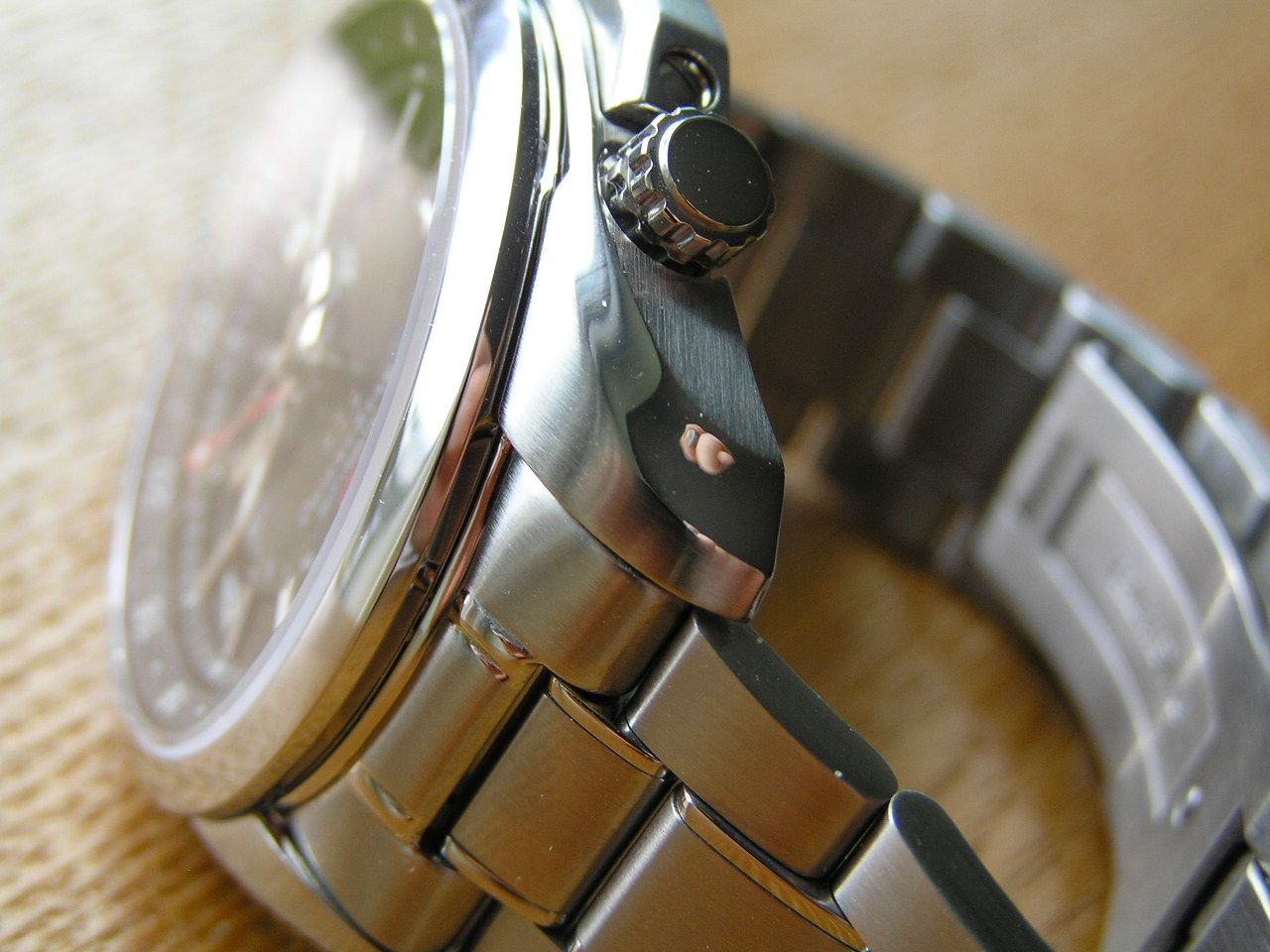
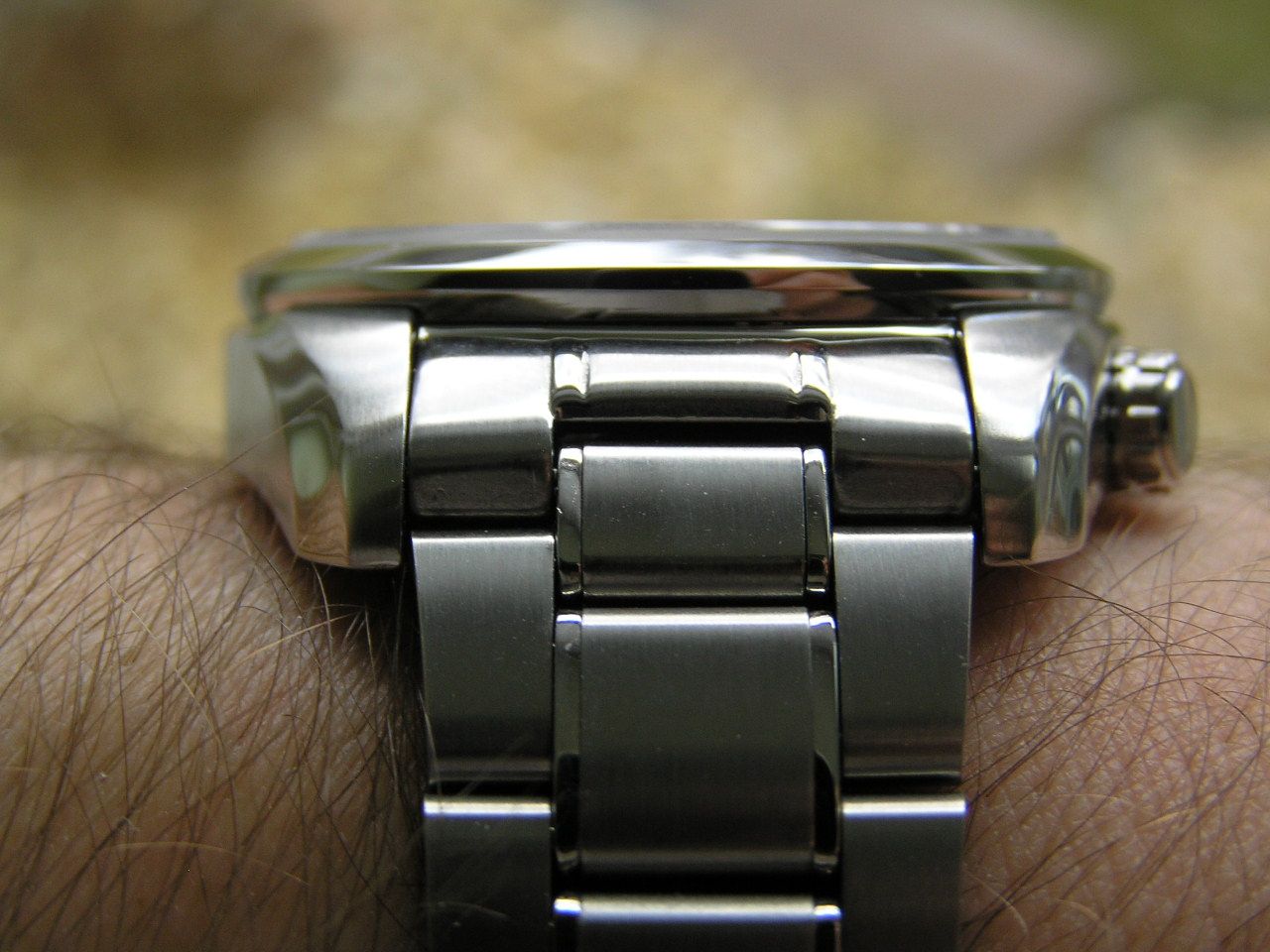
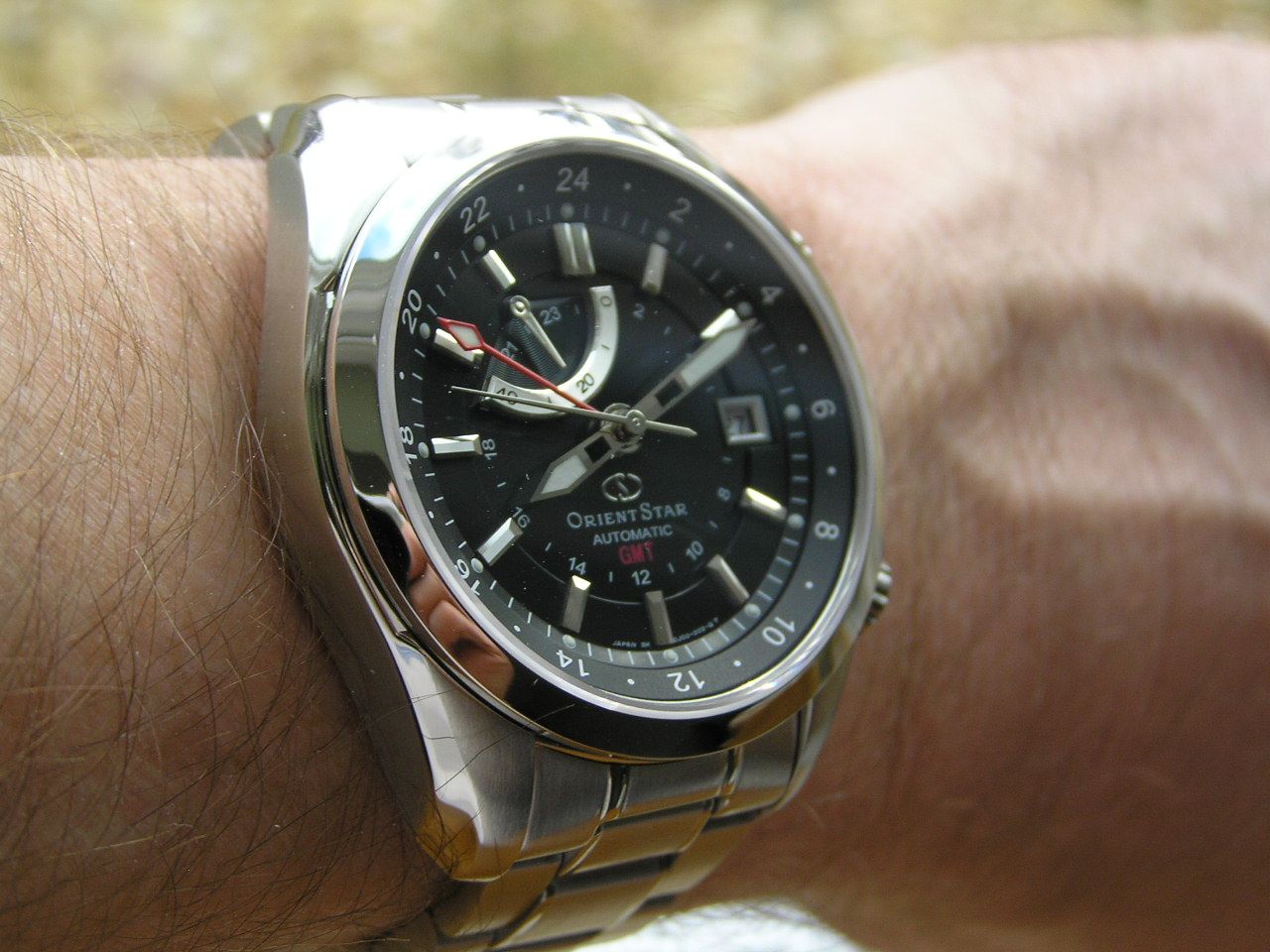
The Star Seeker starts with an all stainless steel case measuring 41.4mm without the two crowns or the rather bulky crown guard.  If the crown guard is factored in, the case measures 44.1mm.  The case is polished and brushed and has an elegant carved style to the sides of the lugs, ala Omega.  The case back screws down and is a display type, showing the mildly decorated movement and a nifty-looking signed and stylized rotor.  Case thickness is 14.2mm, lug width is 21mm. 

On the right side of the case, between the two crowns is a sort of crown protector that is screwed into the side of the case with two screws and fills the gap between the two crowns.  This tends to make the watch look rather ungainly on one side.  The jury is still out on this design element.

The lower crown at the 4 position screws down and is used to rotate the inner 24-hour bezel.  The upper crown at the 2 position is used to wind and set the watch, set the quickset date and adjust the GMT hand in click-set one-hour increments.  The upper crown does not screw down.  Neither crown is signed, which disappointed me.  I love signed crowns and think this Orient Star could benefit from having two signed crowns.  A small quibble, but a quibble nonetheless.

The Star Seeker is factory rated at 100 meters of water resistance.  A quickset date window is located at the 3 position and is outlined with a silver beveled frame.  The date window is black on white.

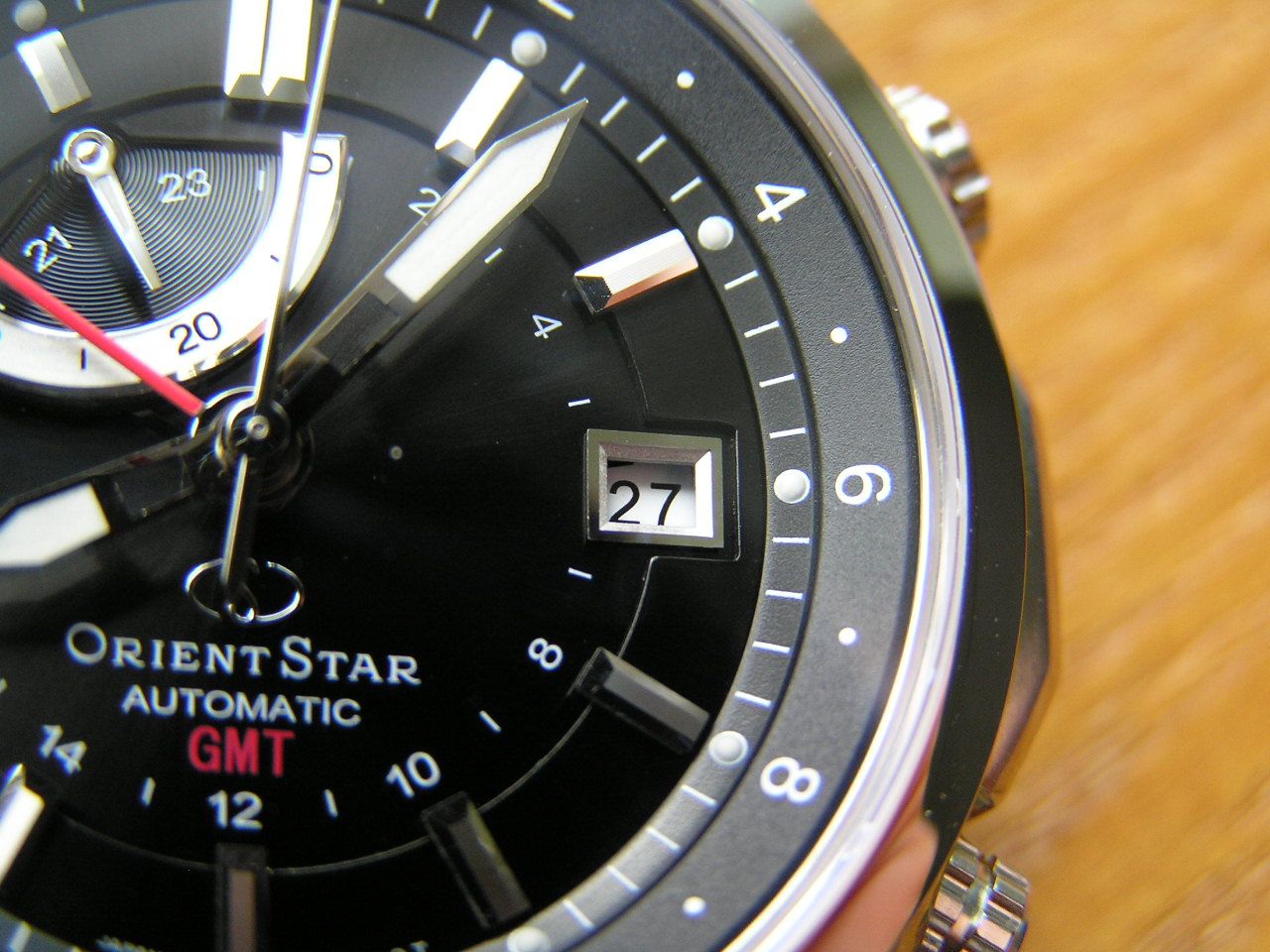
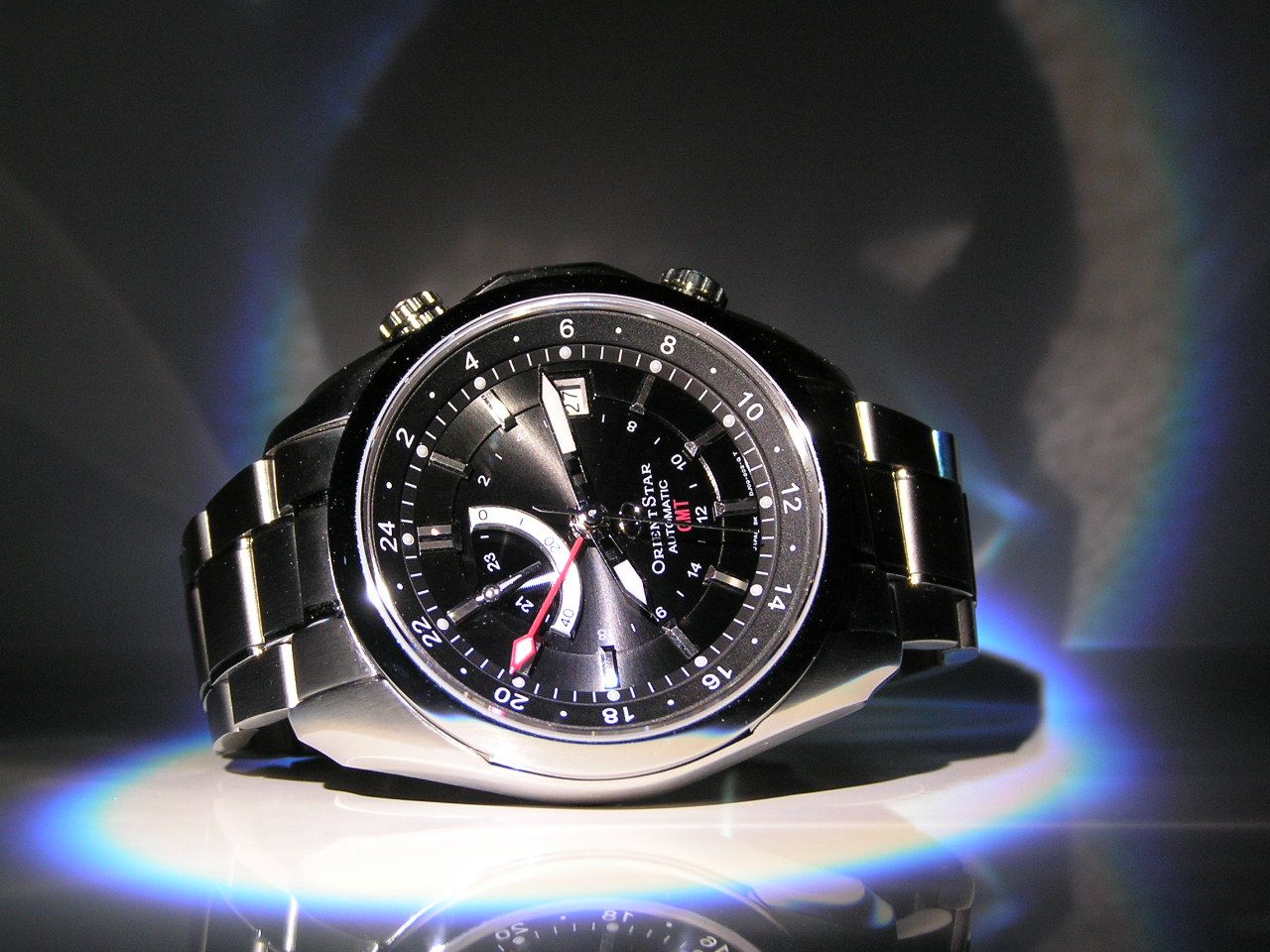
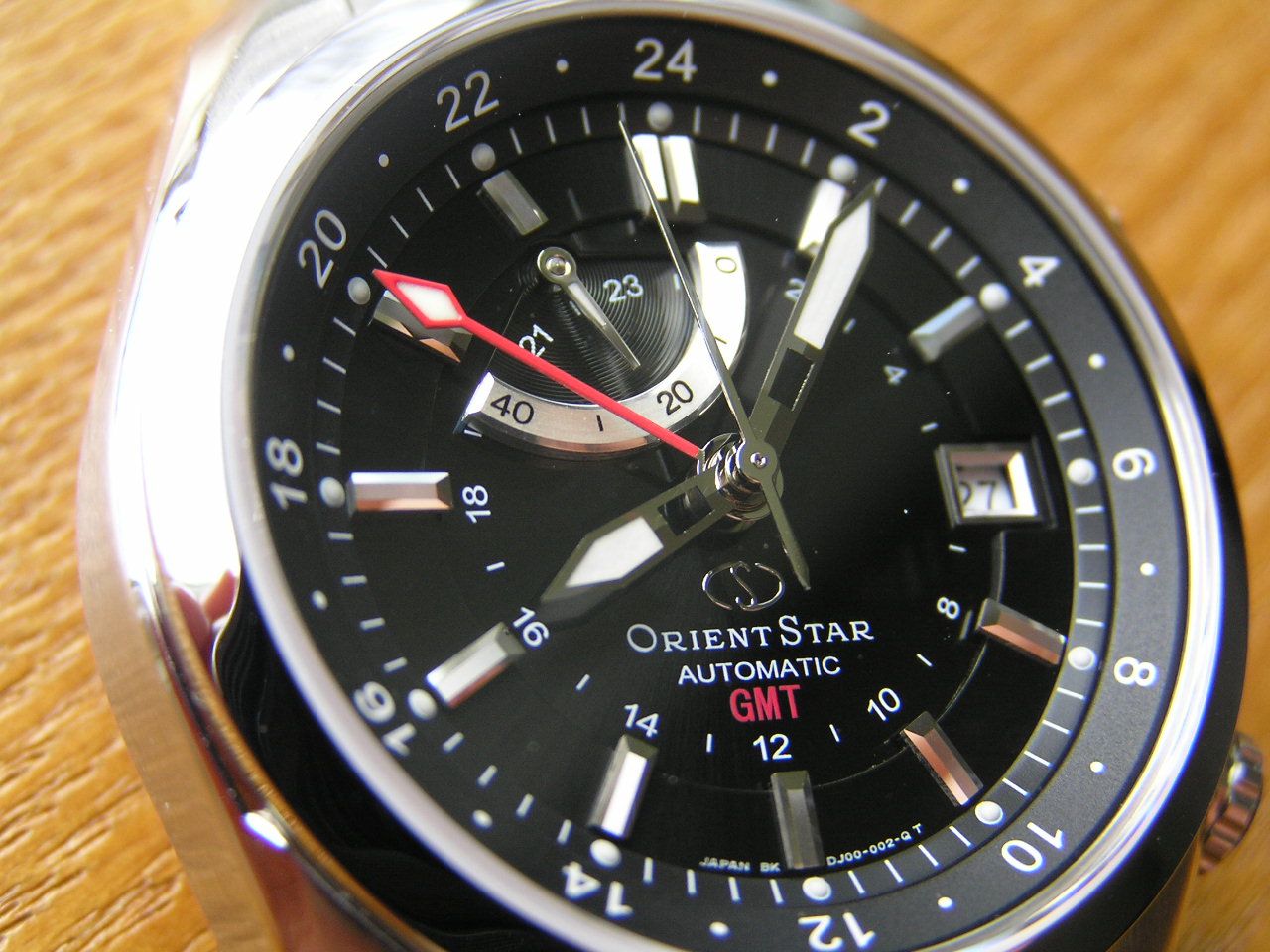
The dial is quite detailed and fairly busy, some may find it a bit disjointed in relation to the location of the power reserve meter.  I think a power reserve meter is a very useful complication to have.  The meter on the Star Seeker is located in the upper left side of the dial, between the 10 and 12 positions.  The meter has a silver lumed pointer and reads up to 40 hours in 10-hour increments.  The scale is applied to the dial and has a nice three-dimensionality about it, with the meter subdial being inset into the dial.

Silver rectangular markers are located at each five minute mark, with the even numbers of the 24-hour GMT scale located at the end of each marker in the inner track of the dial.  The rest of the 24-hour scale (odd hours) is represented by hash marks.  Small lume dots are located on the other side of the markers between the inner rotating 24-hour bezel. 

The dial itself is a deep, glossy black with fairly minimal printing consisting of the Orient Star name and logo, along with the words ‘automatic’ and ‘gmt’, the latter being in red.

The hour and minute hands are semi-skeleton in design and were probably chosen to aid in seeing the power reserve meter as the hands make their way around the dial.  The hands are silver with inset lume.  The seconds hand is a plain, silver tapered stick.  I wish the seconds hand had more style, but I’m sure Orient didn’t want it to compete with the GMT hand.  The GMT hand is thicker, red and sports a lumed arrow-style tip.  Lume quality is in keeping with all of Orient’s latest efforts, read:  very good to excellent.

The dial is capped off by the inner rotating 24-hour bezel that serves as the chapter ring, which also gives this watch three-timezone tracking capability.  This bezel can be rotated in either direction and is not detented, so it can be positioned anywhere around the dial and locked into position with the lower crown.

A flat sapphire crystal with anti-reflective coating tops the dial and protrudes slightly above the stainless steel bezel of the watch.  The crystal does not have any anti-reflective tint to it, partly because the coating can’t be very thick because it doesn’t snuff out all the reflections.  No distortion was noted with the crystal and fit and finish into the case was fine.  Overall fit and finish on the Star Seeker is pretty much first rate.

The Caliber 40P51 movement winds fine and by watching the power reserve meter, you’ll know when the watch has been fully wound.  Hack setting works fine.  I can’t tell you how much of a joy it is to have an Orient that can be manually wound. 

The Star Seeker ran for a strong 47 hours during my testing, besting its 40-hour power reserve meter.  The meter is accurate and can be counted on to let you know the status of the wind with just a quick glance.  My Star Seeker runs about +20 seconds/24 hours, acceptable performance, but I was hoping for a somewhat better showing from this new movement, since it’s bound to form the base of many new watches from Orient and Orient Star.  But the watch is still new and my example may settle down a bit after further wearing.

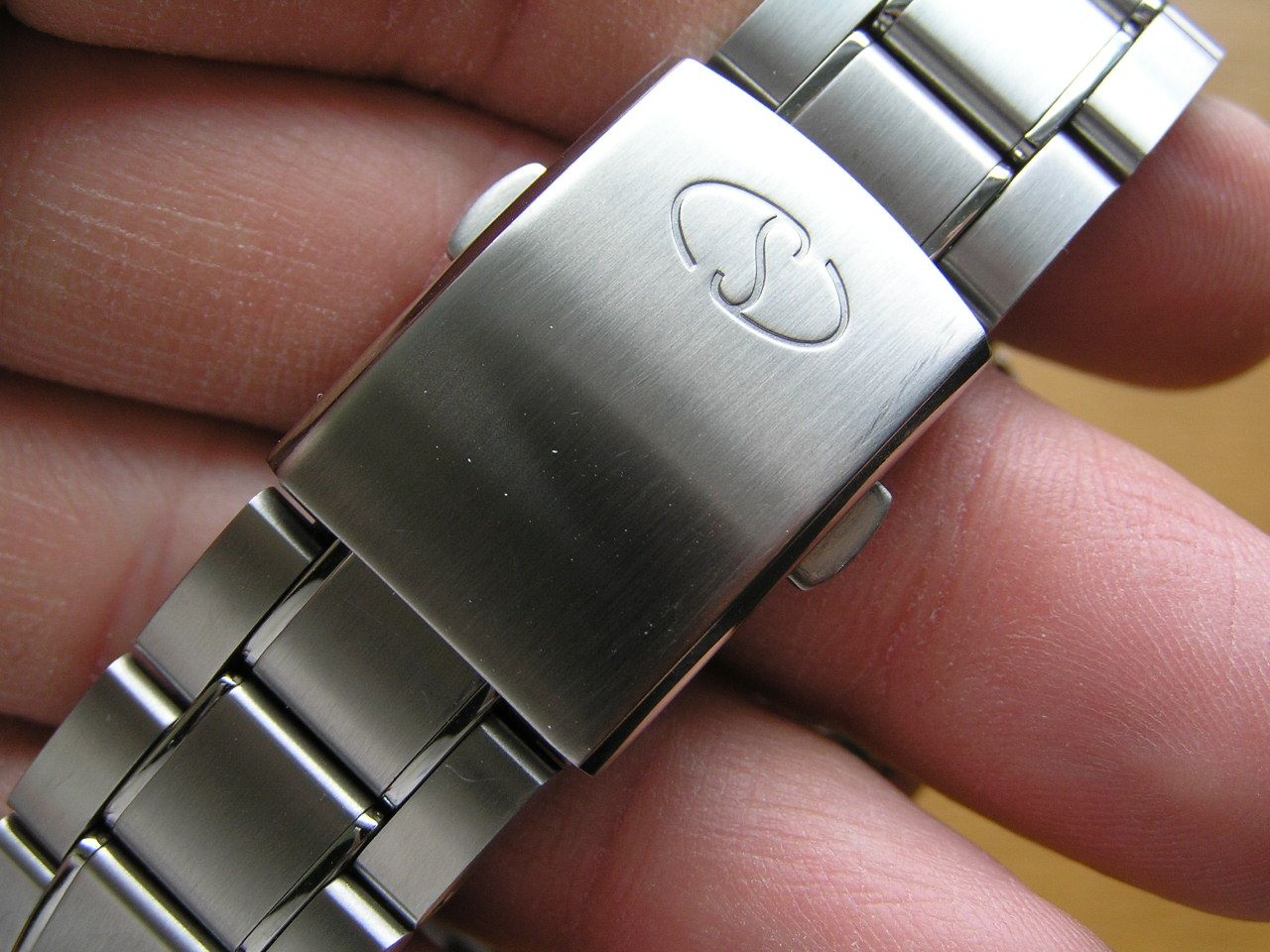
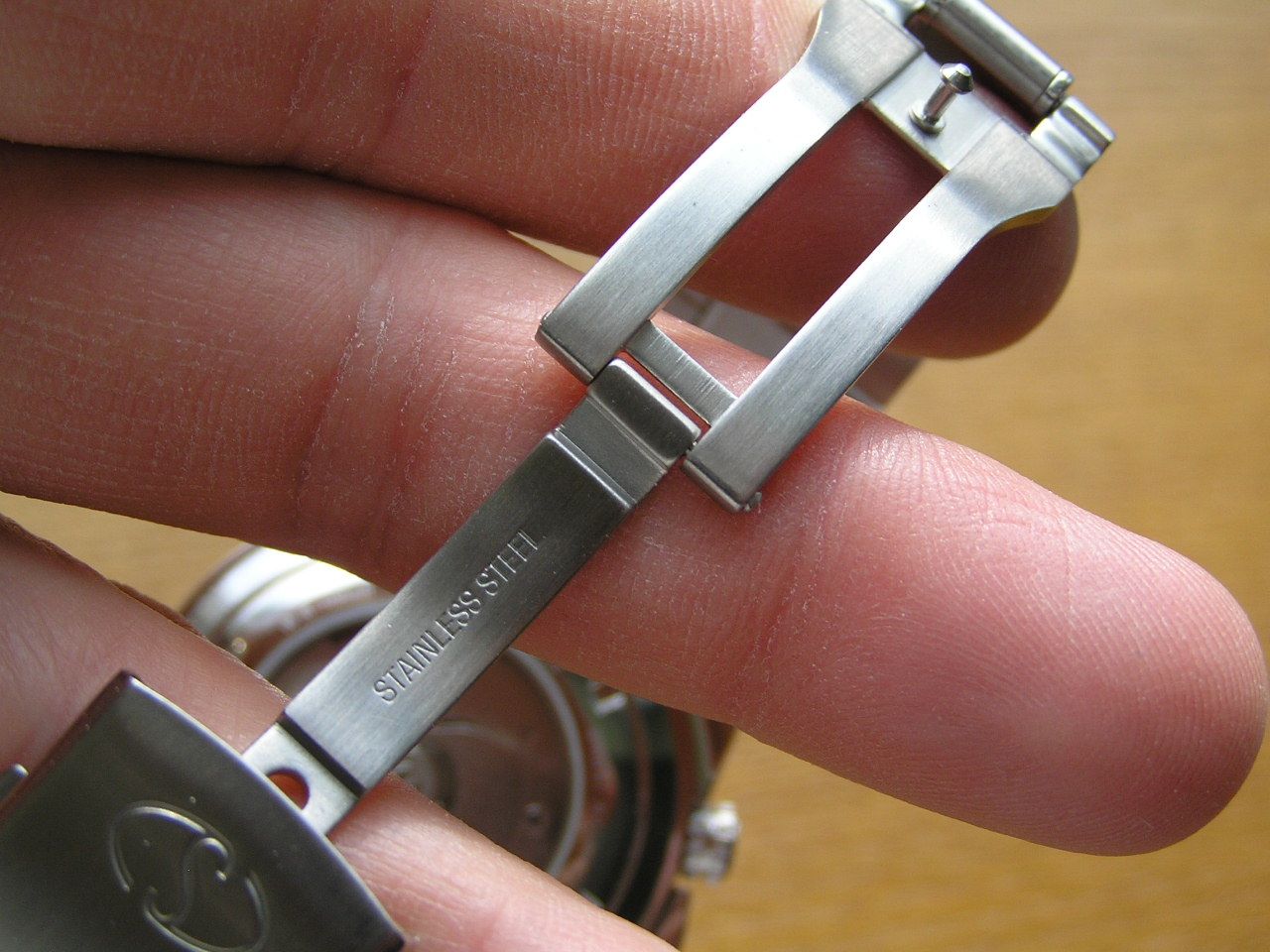
The bracelet on the Star Seeker is a solid link design with tastefully styled polished and brushed links.  The end links are solid.  The clasp is signed and has a pushbutton release.  The deployant is a proper machined type.  The bracelet measures 21mm at the lugs and tapers to 17.9mm at the clasp.  There are three micro-adjustment holes on the clasp to help achieve a good fit.  Bracelet adjustment was easy, with standard split pins securing the links.  The overall presentation of the bracelet and clasp are nice, but for some reason, it still feels a bit cheap to me.  Maybe I’m just getting too picky.

In summary, the Orient Star ‘Star Seeker’ GMT is a superb piece of Japanese horological accomplishment.  If you’re looking for a competent, stylish, reliable GMT watch with a host of quality features at what could be considered a bargain for the feature set, the Star Seeker shouldn’t disappoint.
 

Pros:  in-house automatic movement that hacks and manually winds, power reserve function, independently adjustable GMT hand, sapphire crystal, nice fit and finish

Cons:  some design elements still a bit ‘off’, modest water resistance rating, quality features on bracelet, but it still feels a bit cheap

Verdict:  strong feature set for the price in a unique and reliable GMT timekeeper.  Overall, the Star Seeker is a winner!


Thanks for reading and enjoy the pictures.

Excelsior!

-Marc

Wednesday, December 21, 2011

Review of Ebel 1911 Discovery Automatic Chronograph

Model # 1215794

Brand/Model:  Ebel 1911 Discovery Automatic Chronograph
Movement:  Swiss automatic COSC chronograph
Material:  stainless steel case and bracelet
Complications:  day/date display, chronograph timing up to 12 hours in 1 second increments
Price:  MSRP:  $4,500 USD; street price new $1,850 USD


Plenty of photos follow the review.  Click on the pictures to enlarge.

Ebel is a brand that seems to get passed up by many WISes because it is perceived as more of a fashion brand than anything else.  While this may be true in some regards, Ebel is capable of making some fine timepieces and the 1911 Discovery chronograph reviewed here is a great example of Ebel’s watchmaking expertise in a non-fashion style watch.

Ebel is currently celebrating its 100th anniversary as a true Swiss watchmaker, the name being an acronym of the founder’s names of Eugene Blum and his wife, Alice Levy - Eugene Blum Et Levy.  Ebel’s slogan is ‘the architects of time’ and refers to their dependence on style, overall design and engineering to achieve watches of extreme quality with fashionable looks while never losing sight of their Swiss origin.

The 1911 line has been around since 1986.  The current line-up of 1911 chronographs covers several different models, each with classic good looks and certain trademarks, like the real screws surrounding the bezel, that makes you realize the watch is an Ebel and no other brand.

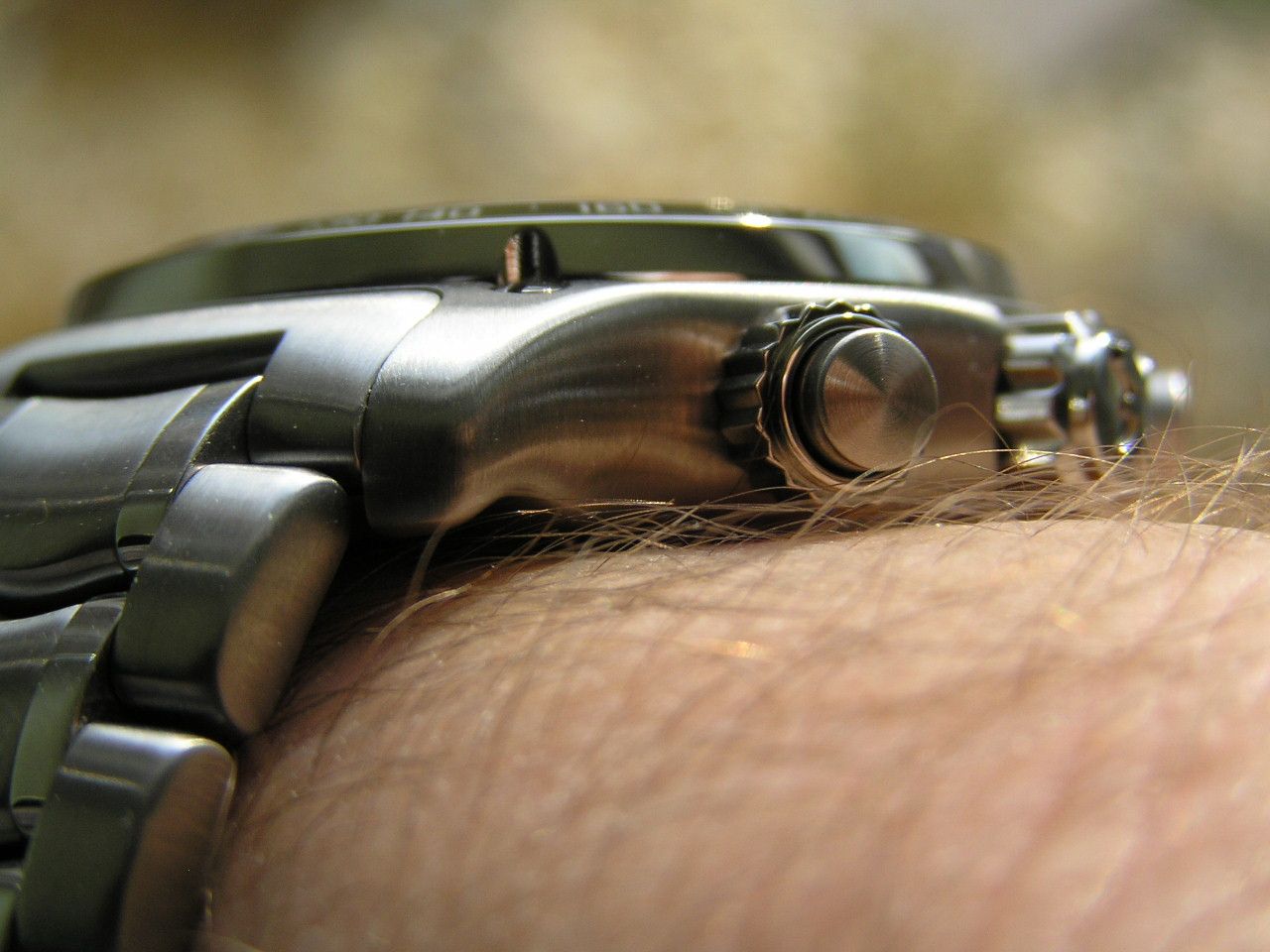
The 1911 chronograph reviewed here starts with a sizeable 43mm case of beautifully brushed-finish stainless steel, a case that exhibits all of its edges and corners having smooth radiused edges, no sharp corners here!  The case is 14.2mm thick, with 22mm lugs.  The case back is secured by eight fine screws and is brushed as nicely as the rest of the case.  The case back protrudes out from the case somewhat, making the case sides lift off the wrist a bit.  The case back is emblazoned with the 1911 logo.  A note about the case, the left side of the case protrudes a bit because it bumps out at the 9 o’clock position (if measured from this bump out to the other side of the case, the case dimension is 44mm w/o crown, 49.2mm crown inclusive).  This doesn’t bother me, but it does make this watch wear even larger.

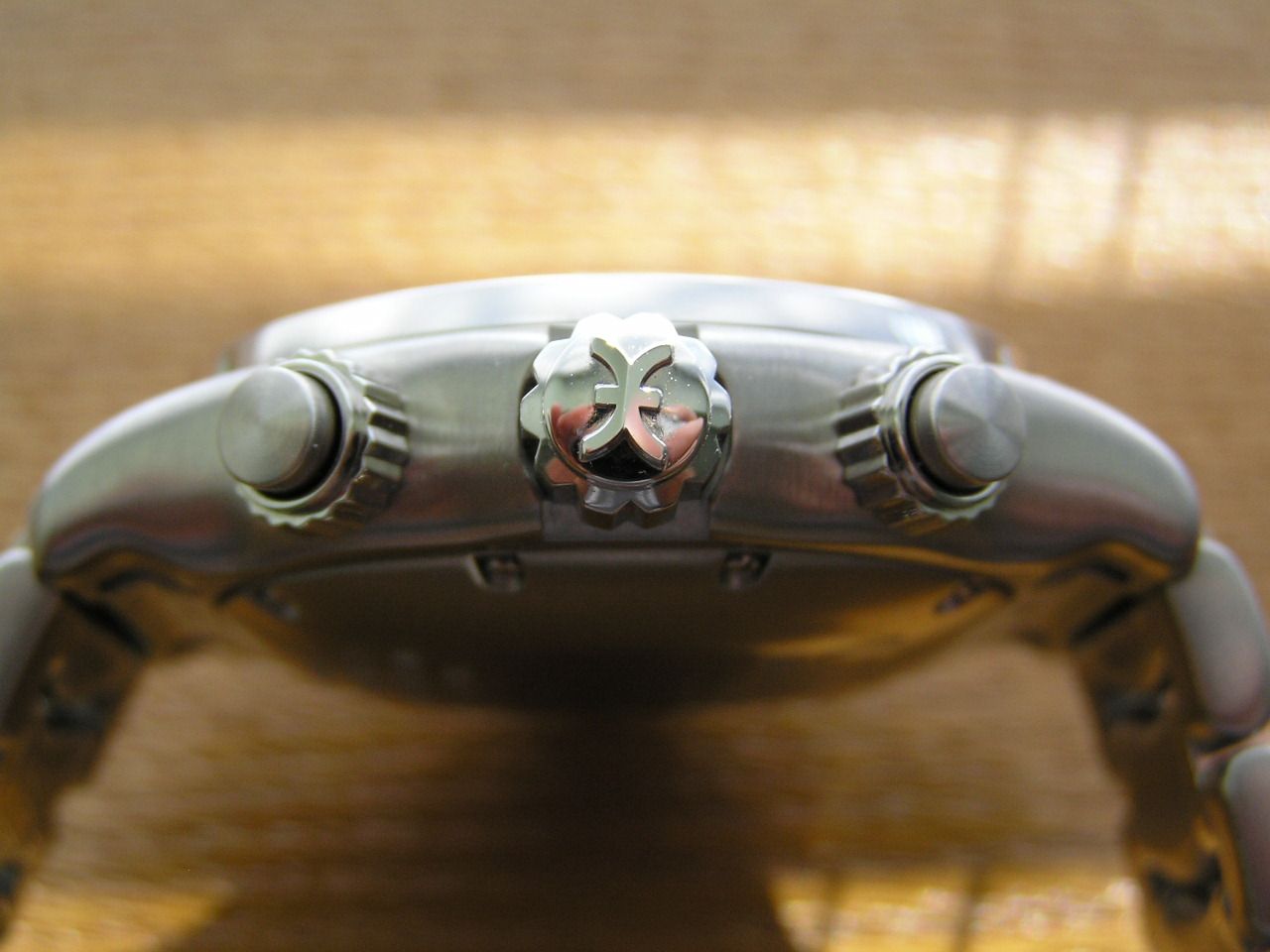
The crown is signed and screws down smoothly with four turns-to-lock.  The chronograph pushers, while they look like they should be screw down, do not screw down.  No biggie, but the faux aspect of this design seems to run counter to Ebel’s tradition of engineering and design excellence.  The 1911 chronograph is factory rated at 100 meters of water resistance.  There are a total of 17 real screws on the case, surrounding the bezel, securing the case back and attaching the bracelet to the case.  These screws give a real feeling of quality to the watch.

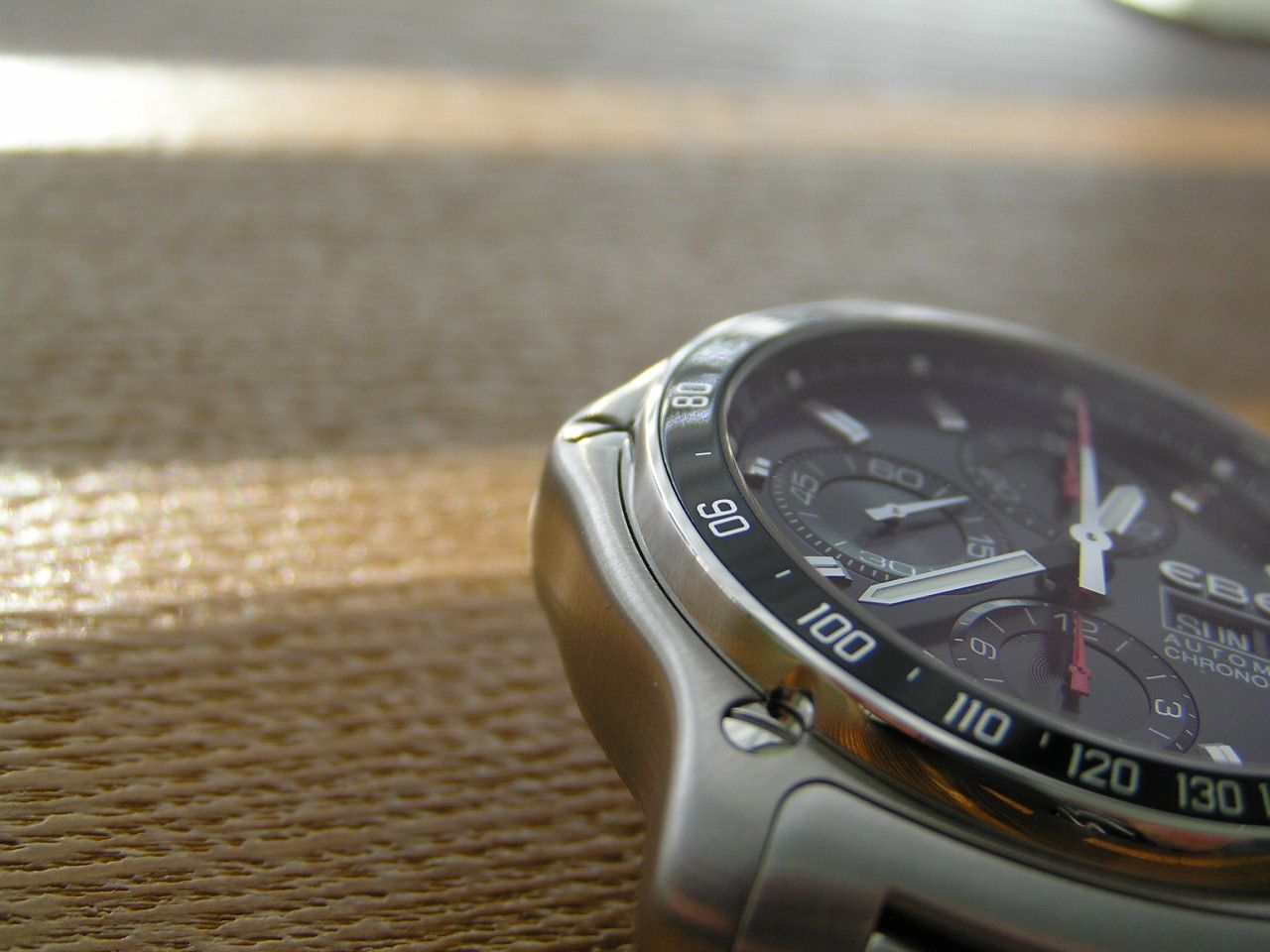
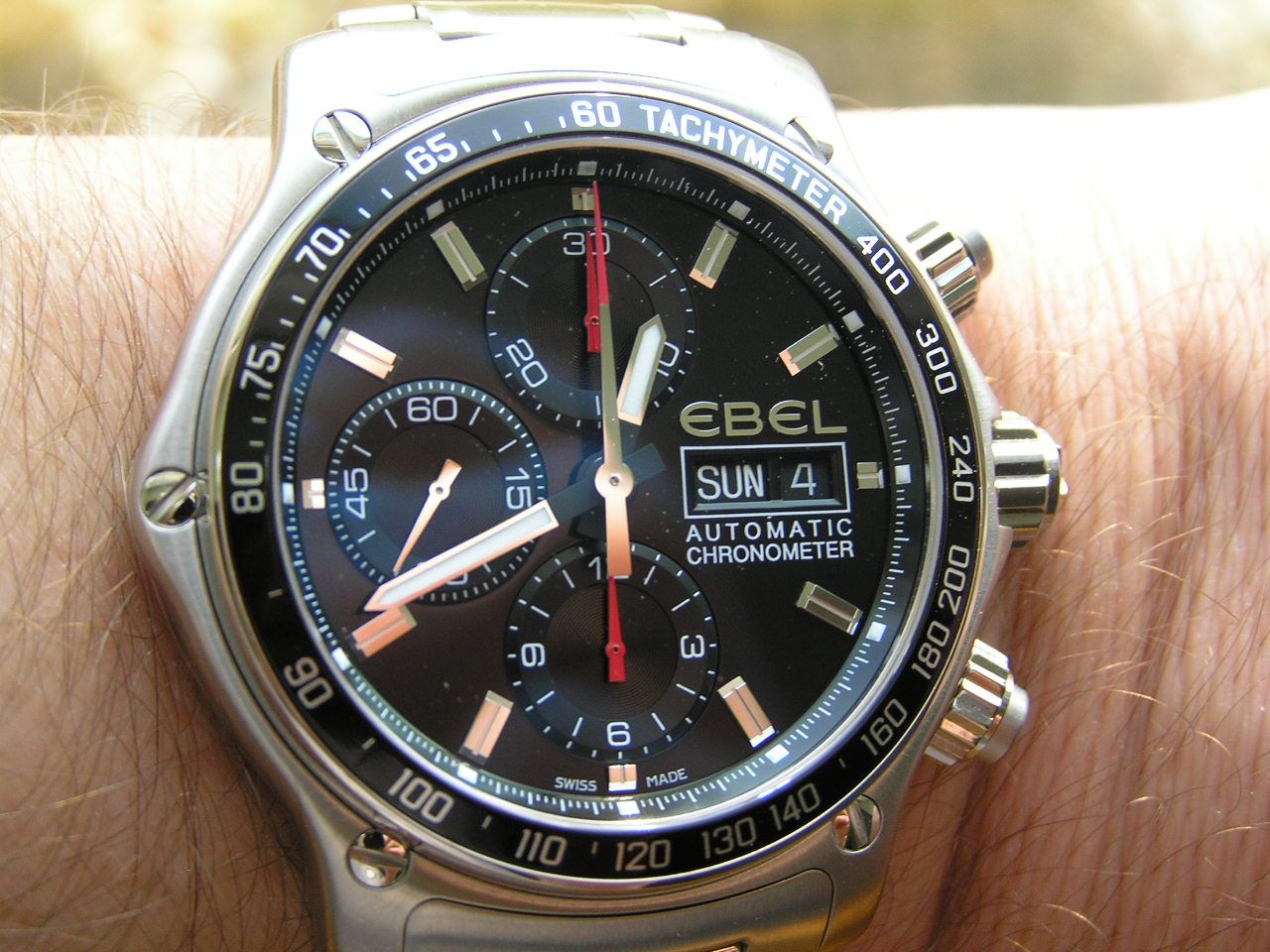
A flat sapphire crystal with anti-reflective coating on both sides covers the dial and gives an incredibly clear view of the dial in all lighting conditions.  This watch is very easy to read.  An aluminum bezel with black tachymeter insert surrounds the crystal.

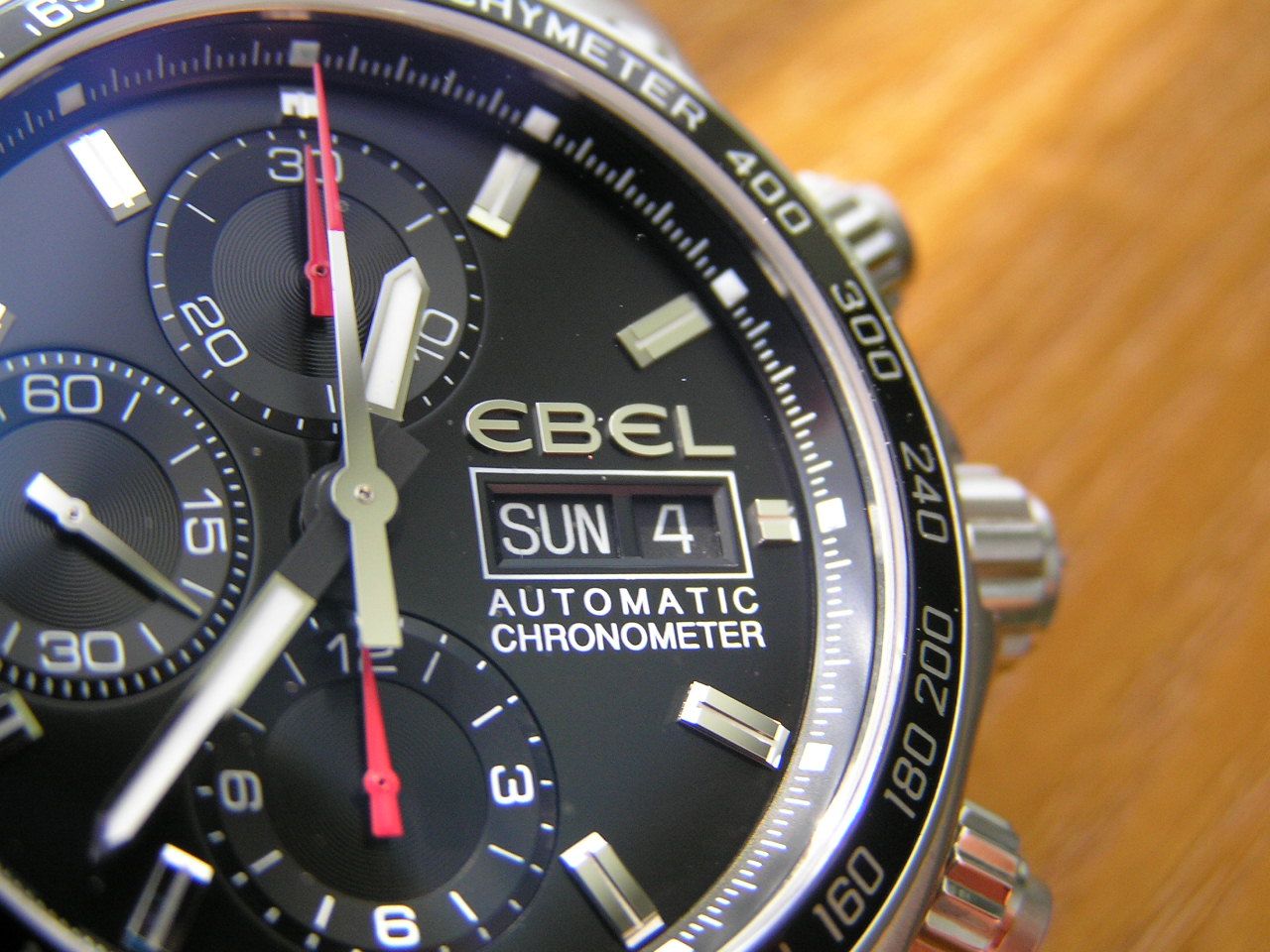
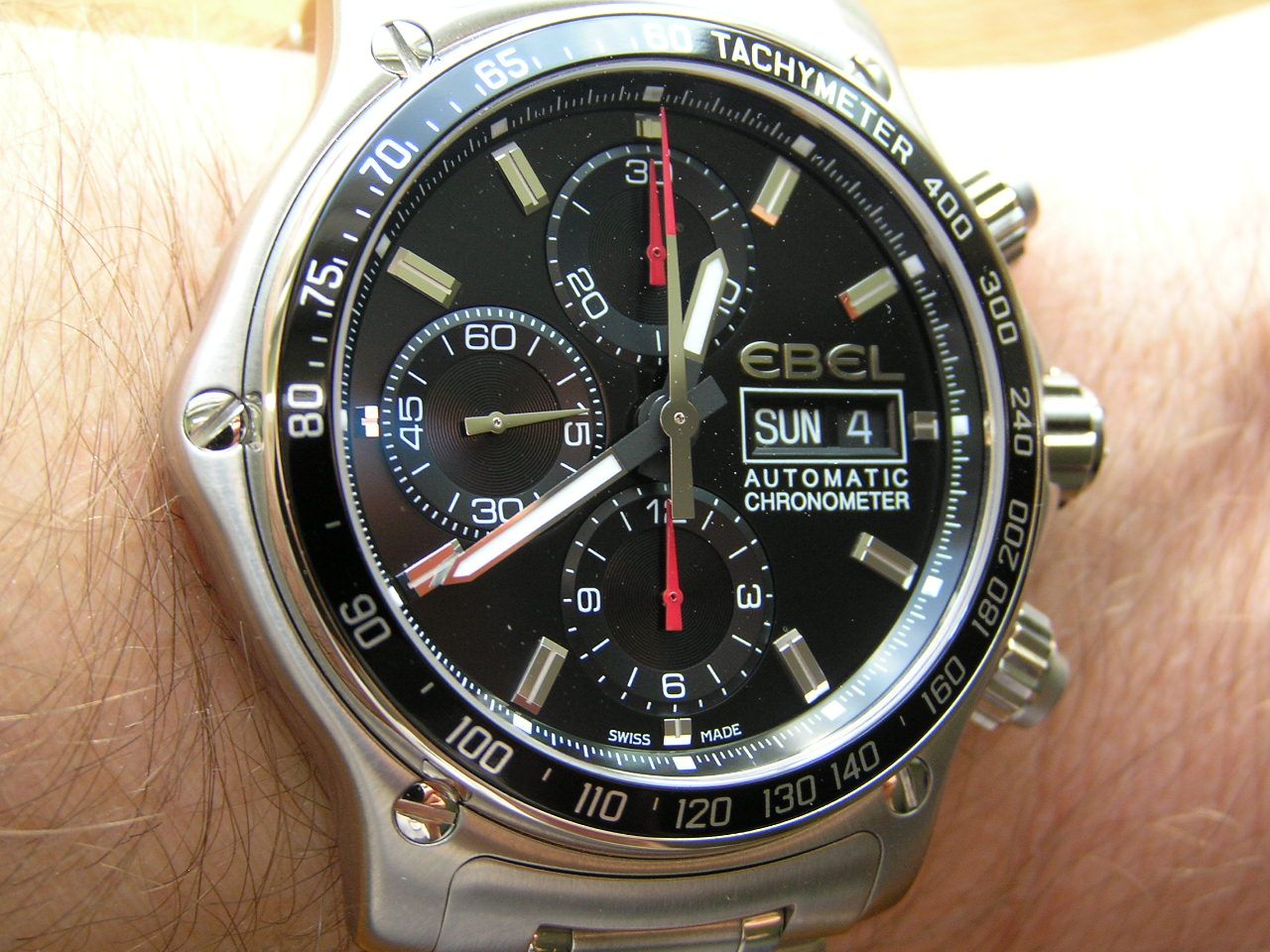
The dial is pure black with applied silver indices with small lume dots on the outside edge of the markers.  The hour and minute hands are silver with inset lume, the center chronograph second hand is silver with a red tip. 


The subdial set up is standard Valjoux 7750.  The subdial at 12 is the chronograph minute counter, the subdial at 6 is the 12-hour chronograph totalizer and the subdial at 9 is the main watch seconds hand.  The subdials are fairly straightforward, slightly dished inwards and have white markers.  The chronograph subdials have red hands, to go along with the red tip on the center chrono seconds hand, to more easily differentiate the chrono timing functions from the standard timekeeping of the watch.  More watchmakers seem to be doing this with their chronographs and I think it’s a good idea.  My recently acquired Seiko Flight Master automatic chronograph uses the same technique, except with yellow hands instead of red.

Lume quality is average, but rather minimal, as only the hour and minute hands and marker dots are luminous.

A quickset day and date display is located at 3, with the wheels a proper white on black that compliment the dial perfectly.  Minimal dial printing consists of the name ‘Ebel’, and ‘automatic chronometer.’  Overall, the dial layout, look and legibility are top notch on the 1911 chronograph. The markers tend to be a bit too shiny at times along with the Ebel name, but it’s a minor inconvenience to an overall superb dial.

And speaking of chronometer, yes, the movement in the 1911 chronograph is a top of the line Valjoux 7750 COSC rated movement (Ebel Caliber 750).  This is especially appealing given the price that these watches can be purchased for and adds a lot to the overall value equation of this model.  The COSC 7750 runs perfectly, winds and hacks with precision and turned in a fine 54 hour power reserve during my testing.  Accuracy meets COSC standards, consistently running at +2/24 hours under my tutelage.  The chronograph starts, stops and resets crisply and the pushers have a nice, firm action about them. 

The only odd thing I have noticed with this watch is the way the hands set through the crown.  There is no resistance at all, the slightest turn of the crown moves the hands.  I don’t know if this is a characteristic of the COSC 7750 because I don’t own any other COSC 7750s or just the way the watch is put together.  It is a bit annoying at first, I would prefer some resistance because it makes hack setting easier, but that’s really the only quibble I have with the movement. 

The bracelet is solid link stainless steel with a continuous link design without any exterior clasp or even a pushbutton release.  You have to yank on the clasp to open it up, very uncharacteristic of a company that prides itself on design and engineering and very inelegant in a fine Swiss timepiece.  Major demerits here from me, almost to the point that I did not even purchase this watch because of this fact.  It annoys me that much.  Even more puzzling is that the machined butterfly clasp is nicely polished and even has perlage on the inside of its small flat surfaces.  So if Ebel takes the time to add a tiny detail like this on the clasp, why can’t they add a pushbutton release?  Just doesn’t make sense to me.

The bracelet measures 22mm at the lugs and tapers to 19.7mm at the center of the clasp.  The finish is finely brushed with two polished middle links and matches perfectly the finish on the case.  The attachment of the bracelet to the case is a proprietary design and is secured with screws.  All well and good, the design works well, but precludes using any aftermarket straps.  You have to purchase a pricey Ebel leather strap if you want to go from stainless to leather.

Despite its fairly largish dimensions, the 1911 chronograph wears well and feels good on the wrist.  This is not a light watch, it has a good heft to it and a definite presence on the wrist.

Presentation is superb, a tan colored genuine leather covered box with a great feel and that real leather smell.  Kudos to Ebel for not skimping here.

The 1911 Discovery chronograph represents a true Swiss-designed and crafted watch from a watchmaker that takes pride in its job to deliver quality and style.  I would add value, as the price of admission for a COSC chronograph is quite affordable.
 
Pros:  COSC Swiss automatic chronograph, legible dial, superb case finish, overall great, sporty looks

Cons:  no pushbutton release on clasp, hands setting overly sensitive, proprietary bracelet/strap attachment to case precludes use of aftermarket straps

Verdict:  strong value in a COSC chronograph, solid feel, great quality, just add a pushbutton on the clasp and this watch would be almost perfect


Thanks for reading and enjoy the pictures.

Excelsior!

-Marc


Wednesday, December 7, 2011

Review of Rado Original Diastar Diver Automatic
Model # R12639163

Brand/Model:  Rado Original Diastar
Movement:  Swiss automatic
Material:  stainless steel case with tungsten-carbide bezel, stainless steel bracelet with titanium clasp
Complications:  date display
Price:  MSRP:  $1,475 USD; street price around $1,000 USD


 Plenty of photos follow the review.  Click on the pictures to enlarge.

My good WIS friend Paul has compared the Rado watch brand to the automaker Saab.  He feels that Rados are quirky, different and run to the beat of a different drum while exhibiting modern design.  As someone who owned Saabs for 30 years, I would agree, except that Rados should be compared to Saab pre-General Motors, but that is an entirely different topic and one that I won’t get into here.  Suffice it to say that a Rado watch is a unique piece of watchmaking expertise.


Prior to my acquisition of this Rado Original Diastar, I had just one Rado in my collection, a classic ‘Captain Cook’ diver from the late 60s.  A super cool watch, but one that doesn’t quite convey the quirkiness that Rado is known for.  I wanted the icon, the classic Rado, and that would be the Original Diastar, introduced in 1962, just five years after Rado was officially founded as a watchmaker in 1957, after being a boutique clockworks since 1917.  Rado has been part of the Swatch Group since 1983.

The Rado Original was billed as the world’s first scratch-proof watch and Rado has carried on this tradition ever since, producing a wide variety of scratch-proof watches and still making an incredibly varied selection of Original styles as well.

The secret to the scratch-proof characteristic of the Original is the use of what Rado calls a ‘high tech hardmetal’ bezel.  Bezel here refers to the part of the watch that surrounds the crystal, but in actuality, the hardmetal bezel on the Original caps about half the case, for a great amount of scratch-proof protection.

The hardmetal bezel is in fact tungsten-carbide, a hard metal on the order of 1400-1700 Vickers on the Vickers hardness scale.  You can visit the Rado web site for more info on how this bezel is formed at the factory and you will get an idea of just how robust it is, as well as appreciating the technology and manufacturing steps involved in achieving this unique component.

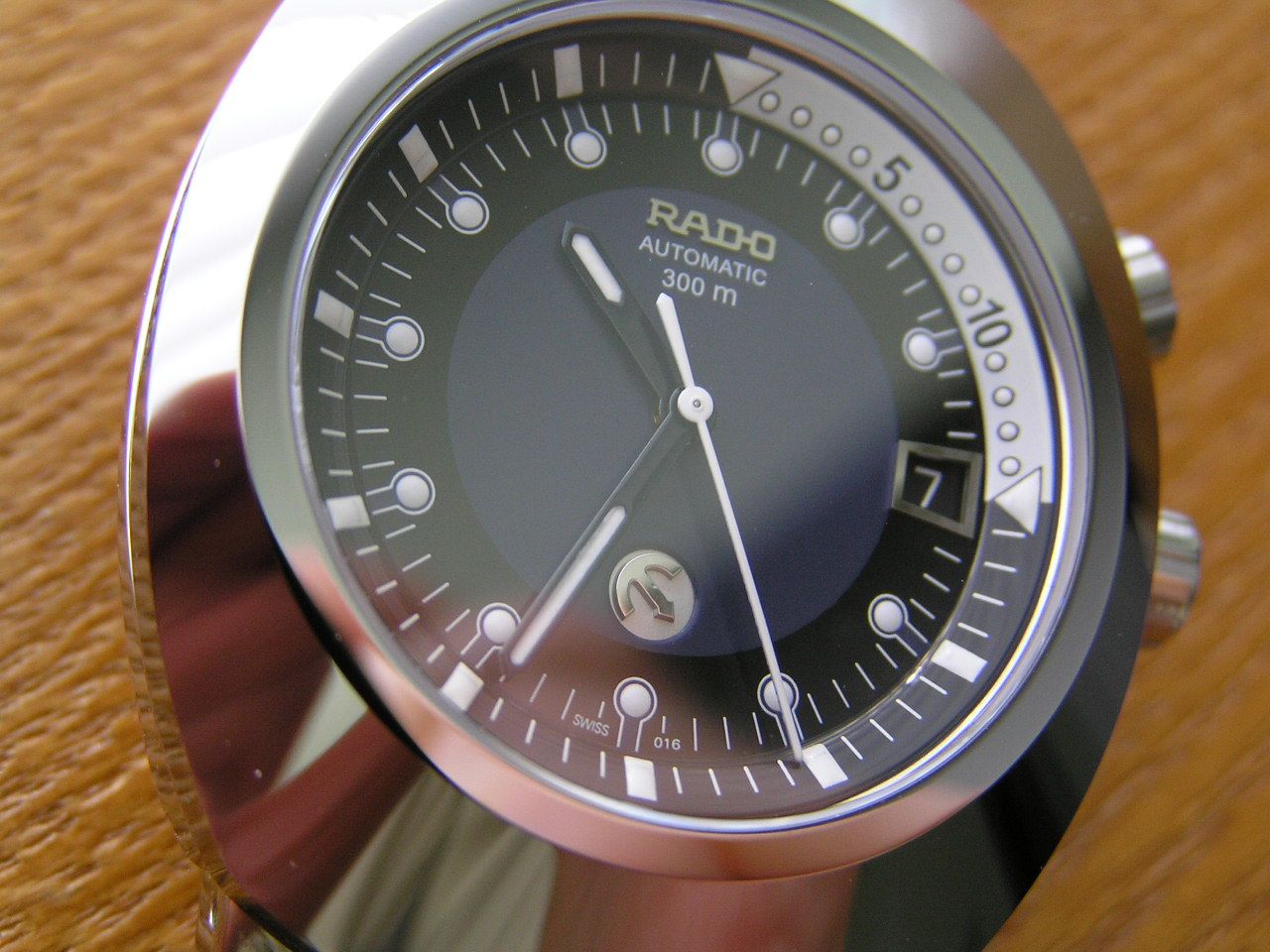
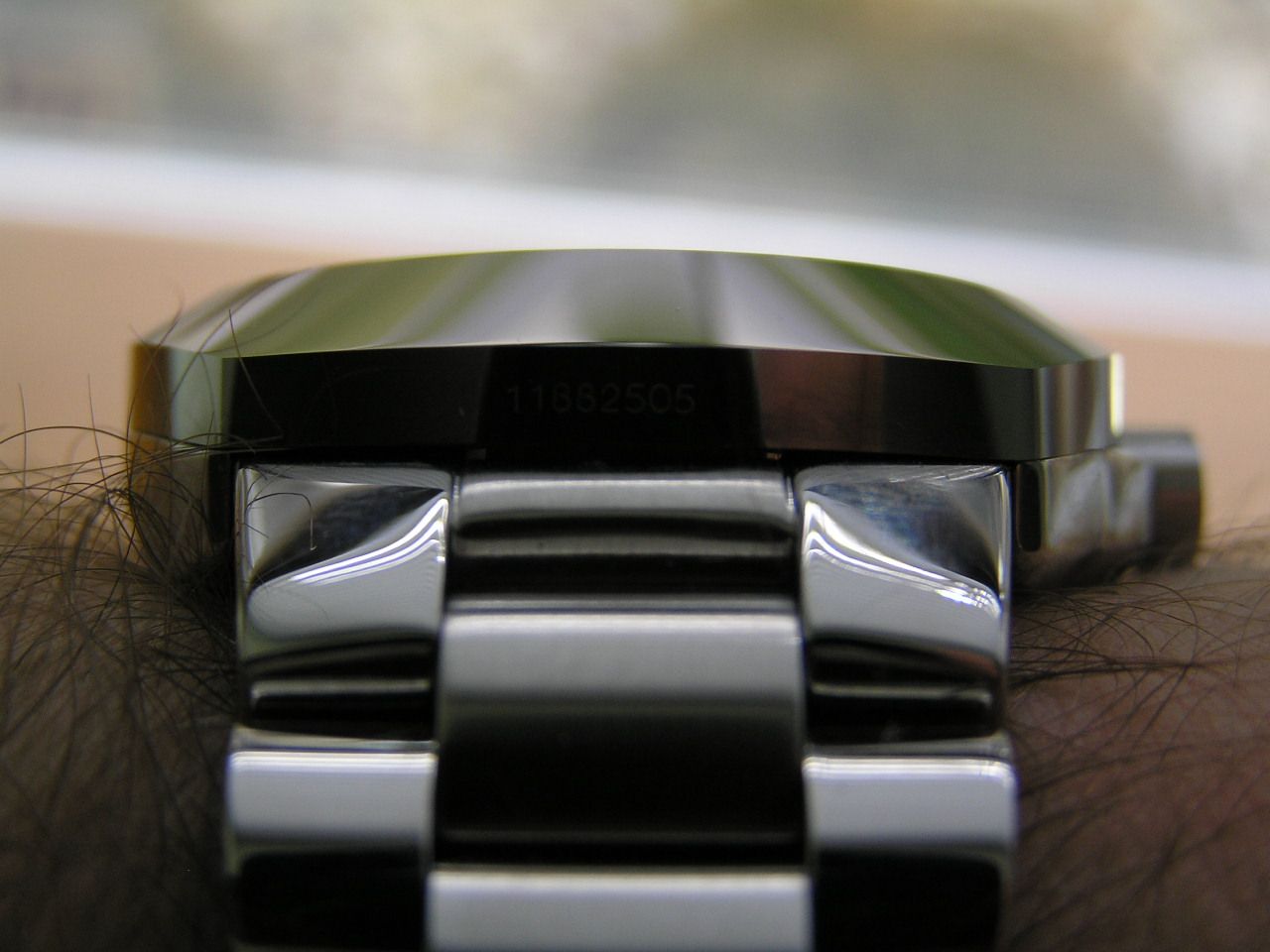
The hardmetal bezel is highly polished and due to the characteristics of tungsten-carbide, I wanted to point out a few interesting facts about it.  The bezel is signed on the left hand side and is also etched with the watch serial number near the lower lug.  The actual color of the bezel is a sort of cool, lighter gun metal grey and contrasts slightly with the stainless steel case and bracelet.  The contrast is subtle and doesn’t detract from the watch’s aesthetics.

Tungsten-carbide is also heavier than steel, and the weight of the bezel is evident when you handle the Rado Original.  I know there are watches on the market purporting to be made entirely of tungsten-carbide and while I have never handled or seen one, I would imagine the weight would be extreme.

Since the bezel is so smooth and highly polished, it is also a magnet for fingerprints, so if you own a Rado Original and caress its beautiful hardmetal bezel, be prepared to do a lot of wiping clean of the bezel to remove skin oils and fingerprints.

Lastly, due to the hardness of tungsten-carbide, this metal, while highly resistant to scratches, is also brittle and if it is struck hard enough or dropped onto a hard surface with enough impact, it can break or shatter into multiple pieces.  I have seen a picture of a Rado hardmetal bezel that was broken into several pieces.  Although I do not know the details of the impact, it illustrated the one negative aspect of this technology.  But don’t worry, in normal use, the hardmetal bezel should stand up extremely well to most abuse you can throw at it.

The Rado Original comes in three sizes, ‘S’, ‘L’ and ‘XL’ in their parlance.  The Rado Original diver adds 300 meter water resistance and a second screw down crown at the 2 position that turns the inner rotating bezel to the standard Originals features.  I love the overall look of this watch and the color combo of the dial, so that’s why I chose it.

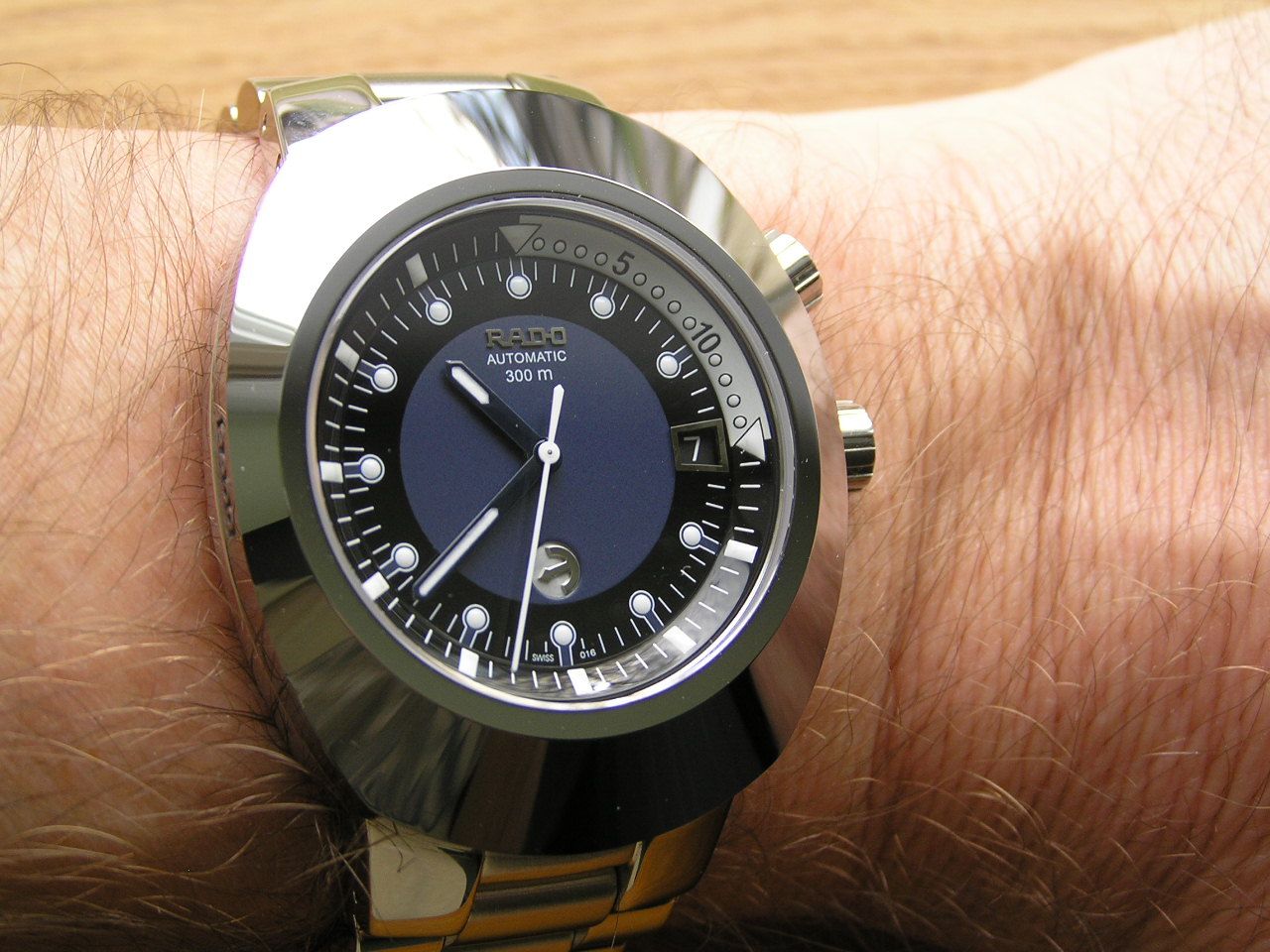
The case on the Rado Original diver is stainless steel, with the hardmetal bezel pressed onto the top half, for a hunk of pretty serious metal.  Both parts of the case are fully polished.  The case measures 38.6mm in diameter without crown, 42.6mm crown inclusive.  Even though the bezel makes the case shape oval, it is not overly long top to bottom (46mm) and sits well on the wrist.  Case thickness is 12.6mm, bracelet width with the bracelet’s semi-integrated lugs measures 24.2mm.  I say ‘semi-integrated’ because the lugs actually pivot slightly to hug the wrist better where the bracelet hooks into the fixed center lug on the case.  I’m usually not a fan of integrated lugs, but this design works much better for me and I would refer to it as a hybrid design.

The case back is polished stainless steel, screws down and is stamped with the famous Rado ‘water sealed’ logo.  Both crowns are signed with the Rado anchor and both screw down.  I do find the main crown a bit hard to use when I wind the watch, as it’s polished and doesn’t have deep fluting, so it’s a bit hard to get a good grip on.

The dial is capped by a flat sapphire crystal without any anti-reflective coating.  Being flat, the crystal affords a clear view of the dial without any distortion.

Overall fit and finish on the Rado Original diver is excellent and is especially good when considering its relatively low price point for such a unique combination of materials.  Nicely done.

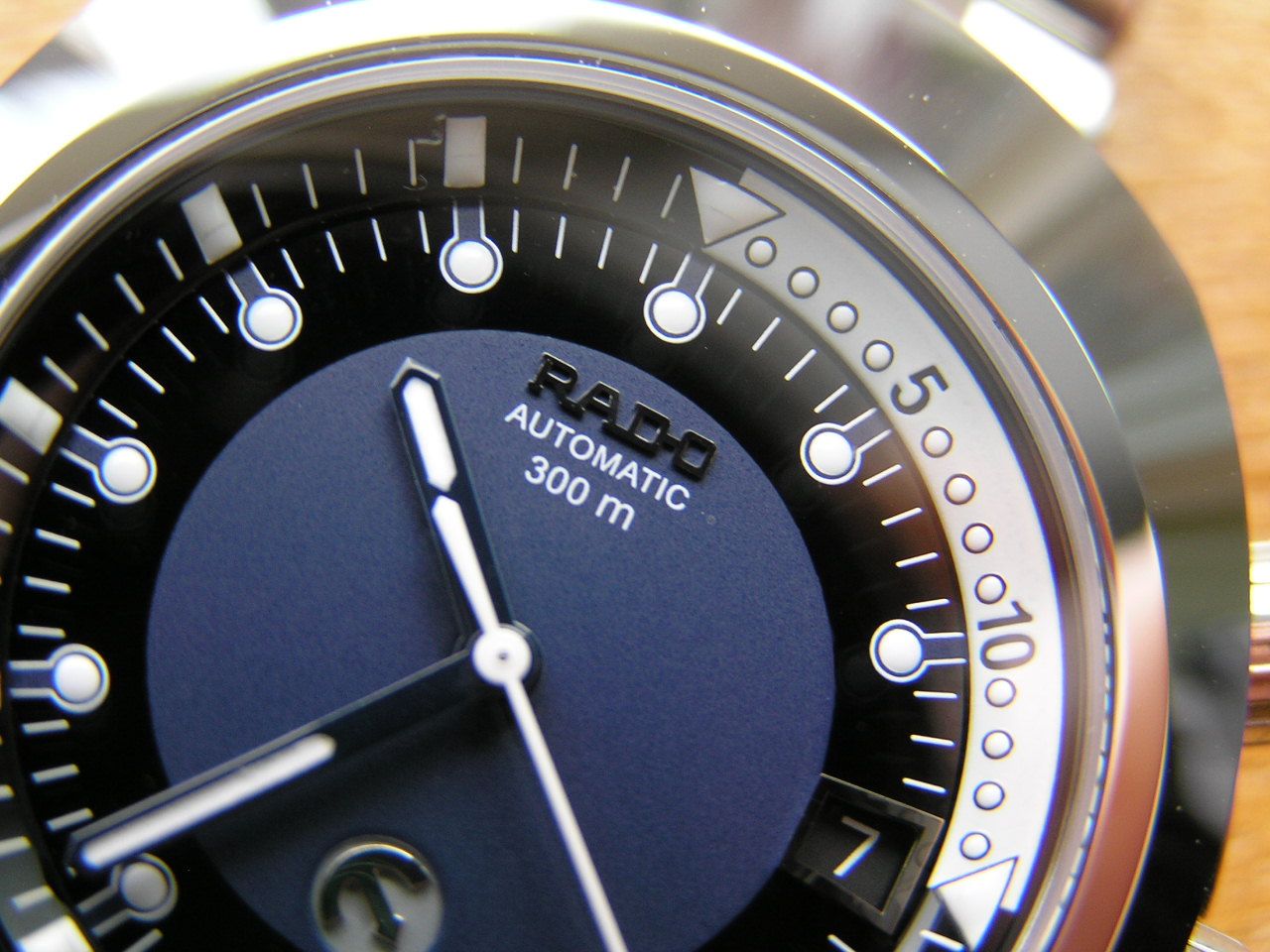
The dial is another focal point on the Original diver.  The center is a blue almost vaguely purple color surrounded by a black seconds track which in turn is surrounded by the inner rotating bezel.  The bezel is black, with the exception of the first 15 minutes, which is done in white.  The hands are done in a dark blue with white inset lume, the seconds hand is plain white (easy to see) and does not have any lume.  Lume quality is acceptable, but not super bright, partly because the lumed parts are rather small and narrow, there’s nothing big and bold with lume applied to it.

Small round applied lume dots are affixed at each five minute mark, while the bezel has corresponding rectangular lume bars, with small lume dots from the 1 to 15 minute marks and a triangular lume pip at the 12.  It’s a legible, clean and good-looking dial presentation.

A quickset date window is located at the three position, the date window being a trapezoidal shape with a white-on-black date wheel.  Minimal dial printing consists of the words ‘Rado,’ ‘Automatic’ and ‘300 M’

The final dial detail is the classic floating anchor symbol, located at the six position.  Sometimes I find myself looking at the anchor first, thinking it is the date window.  Rado places the anchor on the end of a pin so it floats or rotates with the movement of your wrist, rotating freely in any direction.  I always thought it would be cool if the anchor rotated in unison with the second hand, but alas, it does not.

Inside the Original diver beats what I am pretty sure is an ETA 2824-2 automatic movement, but I have not opened the back up to verify this and Rado does not list in detail the origin of their automatic movements.  Timekeeping has been excellent, running at +4/24 hours.  I have only seen 35 hours of power reserve, though, not the expected 42 hour minimum that an ETA automatic should produce, so there may be a slight problem with the movement in my watch, but at 35 hours, it is close enough for me not to mess with.  If it would suddenly drop to 24 hours or less, then I would rectify the situation, but for now, the watch remains as-is.

The Original diver’s bracelet is a solid link stainless steel oyster style with half-round links.  The outer links are polished, the center links are brushed.  The semi-integrated end links are solid.  The bracelet measures 24.2mm at the case and tapers to a rather slim 17.8mm at the clasp. 

The clasp is signed and polished and has a pushbutton closure that opens to one side like a standard deployant, but also has a one-third size deployant on the other side that you pull on to unhook.  When open, the clasp looks somewhat like an unequal butterfly clasp, which in essence is what it is.  The clasp is stamped titanium, which make this the third metal to be used in this watch’s construction.

There are no fine adjustments on the clasp, but the links are not too wide, so at least for me, achieving a good bracelet fit was not a problem.

Presentation is a nice, large black box that’s quite heavy and completely in keeping with a fine Swiss watch.

Overall, the Rado Original Diastar Diver is a unique watch that combines iconic modern design elements with a triumvirate of metals and Swiss quality to boot.

Pros:  unique hardmetal bezel, classic styling, Swiss automatic movement, cool dial, relatively low price point 

Cons:  hardmetal bezel a fingerprint magnet, crown hard to grip to wind watch, semi-integrated lug design precludes the use of standard straps

Verdict:  an iconic watch design that deserves a place in any collection, scratch-proof bragging rights are well-earned, strong overall value with an uncommon design mix


Thanks for reading and enjoy the pictures.

Excelsior!

-Marc